Skip to content
Couponly journal

Saving money, explained

Guides, teardowns and honest advice on saving money online — how coupon codes really work, which sites are worth your time, and when a deal isn't one.

Five tiers of discount ranked by typical size: retention and member portals at 30–50%, verified status at 10–20%, welcome and SMS codes at 10–25%, public codes at 5–15% — labelled as where every coupon site operates, including this one — and cashback at 1–10%

Latest

The Discounts That Never Get Listed

The largest discounts merchants issue never reach a coupon site, because they're built so they can't be shared. Here are nine, and how to get each.

Couponly Editorial8 min read

A creator's link is attributed on day 0, but an extension firing at checkout takes 100% of the commission — leaving a dashboard showing one click and zero conversions

What Creators Should Know About Attribution

You sent the customer. Someone else got paid. Here's the mechanism, what the 2026 enforcement changed, and what to check on your own links.

· 8 min read

A twelve-month grid showing when five categories are cheapest, with November marked as the only month driven by an event rather than by inventory

The Discount Calendar: When Things Go on Sale

Sale events are marketing. Product cycles and season endings are structural — and they're what actually move prices. Here's the calendar month by month.

· 8 min read

A 30-day price history chart where the price climbs steadily before the sale: the banner claims −46% against a €115 run-up price, while the legal reference price of €65, the lowest in 30 days, makes the real reduction −5%

Black Friday: When the Discount Is Real

The oldest trick in retail is inflating a price so the discount looks bigger. EU law now bans it — here's what the rule covers and what it misses.

· 8 min read

On a €100 order the merchant pays one 1–10% commission that last click takes entirely: cashback returns €4.00 in 6–10 weeks but must be activated first and clears a payout threshold, while a coupon code takes €15.00 off at checkout with nothing to remember but no value when no code exists

Cashback vs Coupon Extensions: Which Wins?

They're funded by the same money and they compete for it. Here's how each model works, why they usually can't both win, and which one fits how you shop.

· 7 min read
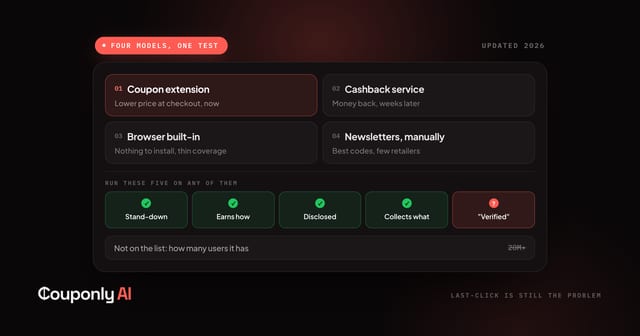
The four alternatives to a coupon extension — coupon extension, cashback service, browser built-in, and retailer newsletters — above the five checks to run on any of them: stand-down policy, how it earns, store-listing disclosure, what it collects, and what it means by verified

Honey Alternatives in 2026: What Changed

The story didn't end where most articles leave it. Here's where things actually stand, the four kinds of alternative, and how to judge any of them.

· 8 min read

The three things a verified badge usually means — no process, an old user vote, or a date recomputed on page load — against what it should mean: the code taken to a real checkout, with the last test time, how many of 19 codes worked, and failures shown

What "verified" actually means on a coupon site

The word is on almost every coupon listing, and on most of them it means nothing at all. Here's what testing a code actually requires — and what no one can promise you.

· 8 min read

A checkout discount field with the code SAVE20 rejected on a $62.00 cart, alongside the reasons it can mean: expired listing, minimum spend not met, an excluded item, plus single-use, new-customer, one-per-order and wrong-region restrictions

Why Your Promo Code Isn't Working

You pasted it, and the store said no. Here are the seven things that actually cause it, how to tell which one you've hit, and what fixes each.

· 8 min read
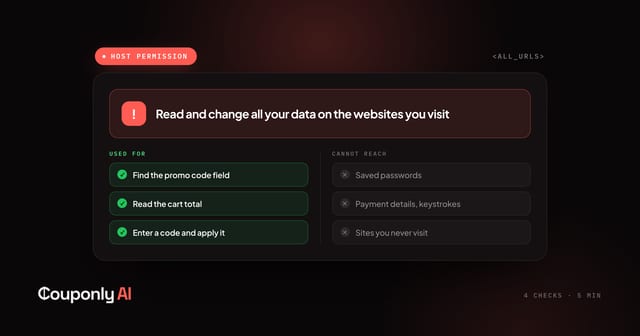
A browser permission prompt reading 'Read and change all your data on the websites you visit', with the three things a coupon extension uses it for: find the promo code field, read the cart total, enter a code and click apply

Are Coupon Extensions Safe? What Their Permissions Actually Allow

Installing one means granting access to every site you shop on. Here's what that permission literally allows, what it doesn't, and how to check what an extension is doing with it.

· 8 min read

Breakdown of who pays whom on a $189.98 order: the shopper pays the store the same price with or without a code, the store pays the extension 1–10% affiliate commission from its own margin, and $0.00 is added to the shopper's total

How Do Coupon Extensions Make Money?

They're free because merchants pay them a commission — not because they're charities. Here's how that money moves, why last-click attribution turned it into a scandal, and what it means for what you actually pay.

· 9 min read