
Cashback vs Coupon Extensions: Which Wins?
They're funded by the same money and they compete for it. Here's how each model works, why they usually can't both win, and which one fits how you shop.

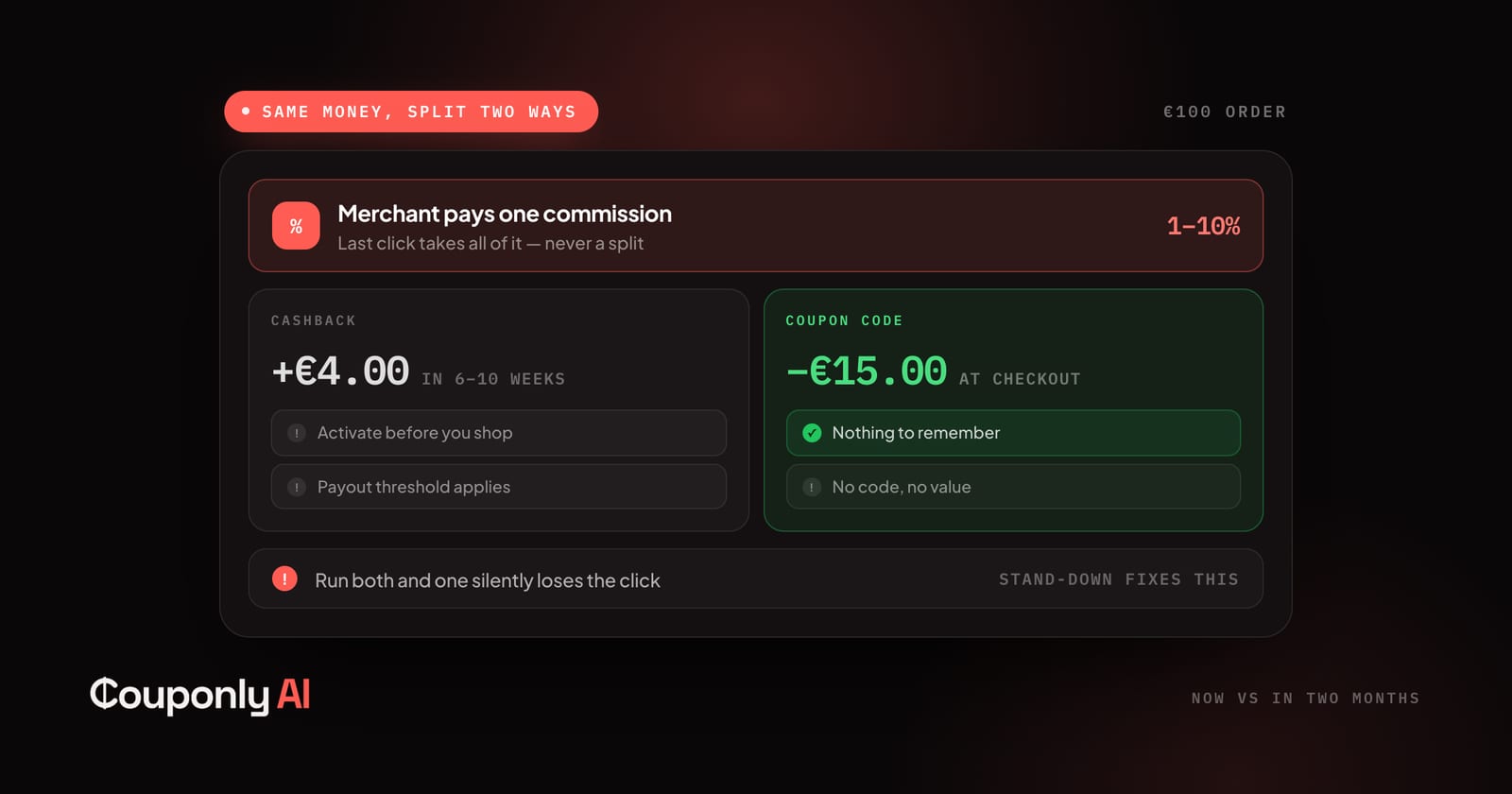
These look like two ways of saving money online. They're closer than that: they're two ways of splitting the same money, and they frequently cancel each other out.
Short answer: both are funded by affiliate commission the merchant pays. A cashback service takes that commission and gives you back a share of it, usually weeks later. A coupon extension keeps the commission and gives you a lower price now, using a discount the merchant published. Because of how attribution works, you generally get one or the other — not both.
Which is better depends on whether the retailer has a code worth using, and on how much you care about getting the money now versus later.
Where the money comes from — in both cases
The mechanism is identical and worth stating plainly, because it explains everything downstream.
A merchant pays a percentage of your order to whichever affiliate partner gets credited for sending you. That's typically 1–10%, out of the merchant's marketing budget rather than added to your price. We covered the full mechanics in how coupon extensions make money.
The two models differ only in what the partner does with that money:
Cashback service: keeps a cut, passes most of the rest to you.
Coupon extension: keeps it, and its value to you is the discount code it found.
So a cashback site isn't more generous than a coupon extension. It's making a different trade — it gives you money back instead of a discount, and it needs you to come to it first.
The friction each one costs you
Neither is free of cost; the costs are just different shapes.
What cashback costs you
You have to activate before you shop. Click through from the cashback site or hit the extension button before you buy. Forget, and you get nothing. This is the single largest source of cashback that never arrives.
You wait. Retailers hold commission through the return window, so confirmation typically takes weeks and can run to months. The money is real but it isn't yours yet.
Thresholds and expiry. Most services have a minimum payout, and balances below it sit indefinitely. Some expire dormant accounts. Read those terms before you count the balance as savings.
Claims can fail. If tracking breaks — an ad blocker, a cookie prompt, a redirect — the transaction may not register. Most services let you file a missing-cashback claim, and the process takes weeks with no guaranteed outcome.
What a coupon extension costs you
Broad browser permissions. It has to read the pages you shop on to find the code field. That's a real trade and we went through it properly in are coupon extensions safe.
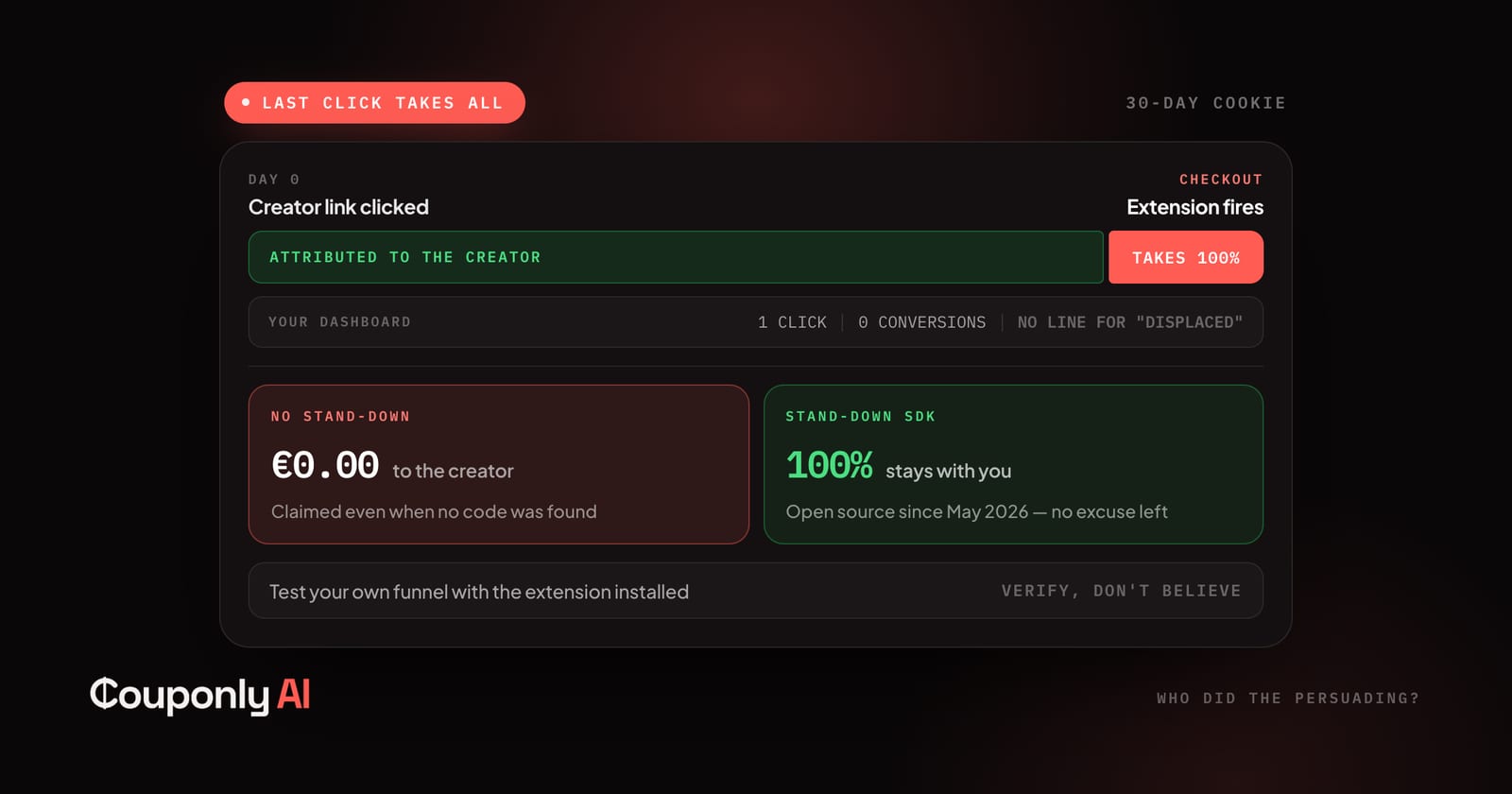
It might take someone else's commission. This is the cost that isn't yours — it's the creator's. An extension that overwrites an existing affiliate attribution is billing a third party for your decision. That was the substance of the 2026 enforcement actions across the affiliate networks.
No code, no value. If the retailer has no working public code, the extension has given you nothing. Cashback, by contrast, pays out at some rate on virtually every eligible order.
Why you usually can't have both
Here's the part most comparisons skip.
Affiliate programmes almost all use last-click attribution: whoever's tracking link was clicked most recently before purchase takes the whole commission. Not a split.
So when you activate cashback and then let a coupon extension act at checkout, one of them ends up credited and the other gets nothing. If the extension takes the click, your cashback silently fails to track — and you find out weeks later when it never appears.
Three practical consequences:
A well-behaved extension will stand down. If an affiliate attribution is already attached to your visit, an extension following a stand-down rule leaves it alone. That's what protects your cashback. Since May 2026 there's an open-source SDK for detecting this, so a tool that gets it wrong is choosing to.
Read this as a feature, not a limitation. An extension that always grabs the click will show you more of its own "wins" and quietly cost you cashback you'd already earned.
Coupon codes themselves usually still work. The code is applied by the store's checkout, independent of who gets the commission. What conflicts is the attribution, not the discount.
Which one actually saves more?
Do the arithmetic on the order in front of you rather than on the model.
Cashback is a percentage of your order, and rates are usually low single digits, occasionally higher on categories like fashion or travel. On a €100 order at 4%, that's €4 — arriving in a month or two.
A coupon code, when one exists, is often 10–20% off, applied immediately. On the same €100 order, a 15% code saves €15 today.
So when a working code exists, the code usually wins outright, and it wins now. When no code exists — which is common, since most listed codes don't work — cashback wins by default, because a small guaranteed percentage beats zero.
Two adjustments to that:
Cashback rates spike during promotions. Elevated rates around major sale events can push cashback above what any public code offers. Check before assuming.
Codes and cashback both lose to the actual price. A retailer with a lower base price beats either. The total at checkout is the only number that matters, which is a boring conclusion and still the correct one.
A rule of thumb
Situation | Use |
|---|---|
Retailer usually has working codes | Coupon extension |
Large order, low-discount category (electronics, groceries) | Cashback |
You already clicked a creator's link | Neither — let their attribution stand |
Major sale event | Check cashback rate first, it may be elevated |
You'll forget to activate | Coupon extension — nothing to remember |
You want the saving now, not in two months | Coupon extension |
That last row is not trivial. Deferred savings that require you to remember a step, wait through a hold period, and clear a threshold are worth less than the same amount today — and a meaningful share of them are never collected at all.
Where we stand
We build a coupon extension, so read this as an interested party.
We don't do cashback and don't intend to. If you want money back rather than a lower price, use a cashback service — that's a real recommendation, not a hedge.
What we do is test codes against real checkouts, rank by freshness, measured success rate, and price with no paid placement, and leave existing affiliate attribution alone. That last one is what makes us safe to run alongside cashback: if you activated a cashback offer before shopping, our extension doesn't take that click away from you. The commitments and their limits are on why you can trust Couponly.
If you're weighing this against other options entirely, the four models are laid out in Honey alternatives in 2026. To check what's live at a specific retailer, start from the store directory.
Frequently asked questions
Can you use cashback and a coupon code at the same time?
The coupon code itself will usually still apply, because the store's checkout handles it independently. What conflicts is the commission: under last-click attribution, whichever partner touched your visit last gets credited, so a coupon extension that takes the click can cause your cashback to fail to track. An extension that applies a stand-down rule leaves your existing cashback attribution alone.
Is cashback better than coupon codes?
Neither is better in general. Cashback pays a small percentage — often low single digits — weeks or months after purchase, on almost any eligible order. A coupon code, when one exists, is frequently 10–20% off and applies immediately. When a working code exists it usually wins; when none does, cashback wins by default.
Why didn't my cashback track?
Most often the offer wasn't activated before purchase, or something overwrote the tracking between the click and the order — another extension, a redirect, a cookie prompt, or an ad blocker. Most services accept missing-cashback claims, though the process takes weeks and outcomes aren't guaranteed.
Do coupon extensions steal cashback?
They can. If an extension overwrites the affiliate attribution your cashback service set, the commission goes to the extension and your cashback doesn't track. Extensions that implement stand-down detection leave existing attribution in place; since May 2026 there's an open-source SDK for exactly this, so the behaviour is a choice rather than a technical limitation.
How long does cashback take to pay out?
Typically weeks, sometimes months. Retailers hold commission through the return window before confirming it, and services then have their own payout schedules and minimum thresholds. Balances below the threshold can sit unpaid indefinitely.
Does cashback cost me anything?
Not directly — it comes from the merchant's commission, not from your price. The real costs are indirect: remembering to activate, waiting for confirmation, and the share of cashback that never tracks or never clears the payout threshold.
Keep reading
What Creators Should Know About Attribution
You sent the customer. Someone else got paid. Here's the mechanism, what the 2026 enforcement changed, and what to check on your own links.
Couponly Editorial
The Discount Calendar: When Things Go on Sale
Sale events are marketing. Product cycles and season endings are structural — and they're what actually move prices. Here's the calendar month by month.
Couponly Editorial
Black Friday: When the Discount Is Real
The oldest trick in retail is inflating a price so the discount looks bigger. EU law now bans it — here's what the rule covers and what it misses.
Couponly Editorial