
The Discounts That Never Get Listed
The largest discounts merchants issue never reach a coupon site, because they're built so they can't be shared. Here are nine, and how to get each.

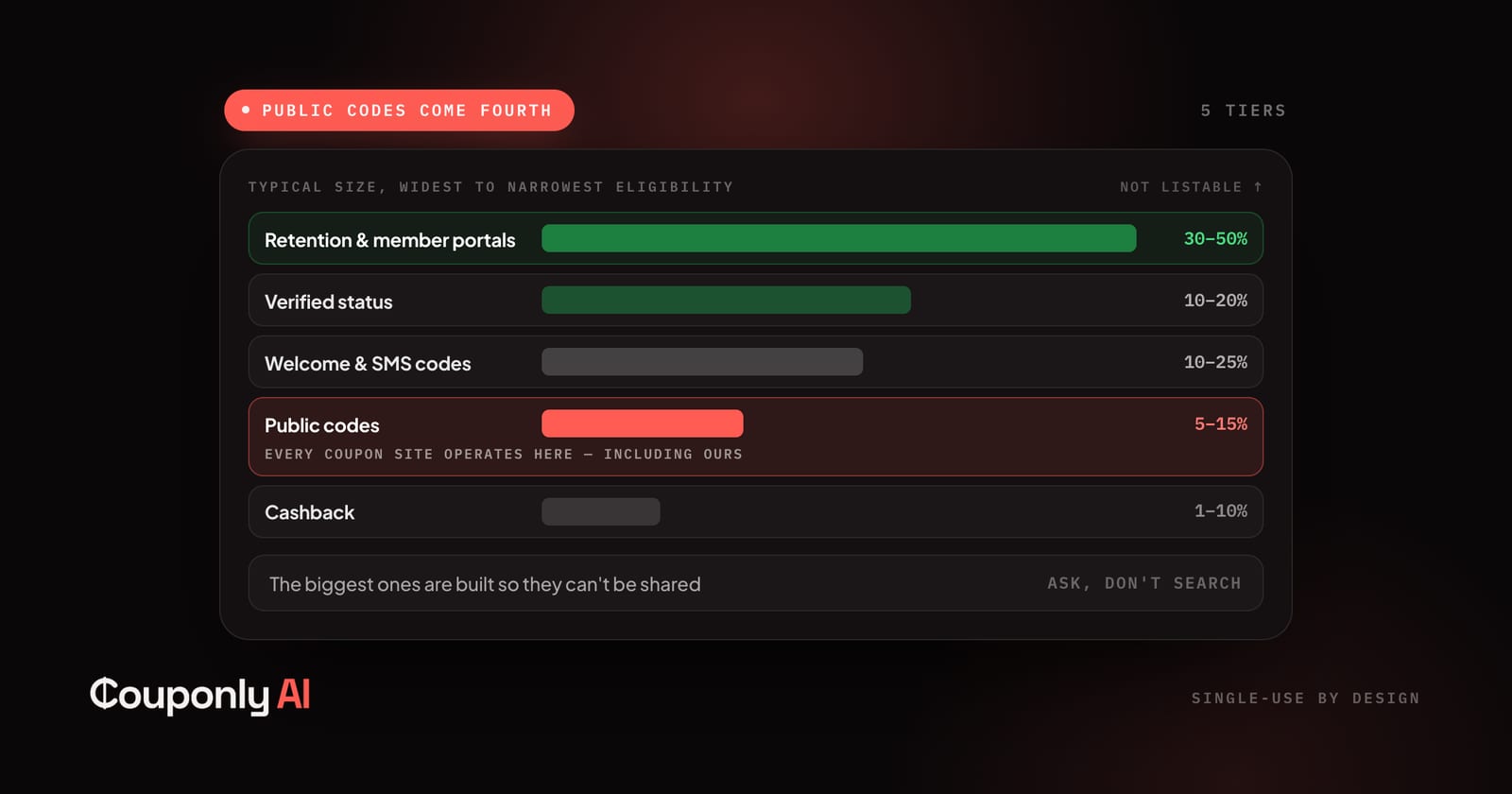
There's a category of discount that no coupon site can show you, no extension can find, and no aggregator will ever list — not because they're hidden, but because they're built so they can't be shared.
Short answer: the largest codes a retailer issues are usually single-use, account-bound, or gated behind identity verification. A welcome code tied to your email, a student discount tied to your enrolment, a retention offer generated when you try to cancel. These are frequently double the size of anything public, and getting them is a matter of asking rather than searching.
Nine of them, with what each is typically worth and what it costs you to get.
Why these never reach a coupon site
The economics are simple. A merchant issuing a public 10% code accepts that everyone will use it, including people who would have bought anyway. A merchant issuing a personal 20% code to a first-time visitor is buying a customer they didn't have.
The second is worth more to them, so it's bigger — and it's engineered to be non-transferable, so it can't leak. Single-use codes, account-bound codes, and verification-gated codes are all doing the same job: making sure the discount reaches the person it was meant for.
This is also why they show up in the data. When we look at where working codes come from, merchant-issued sources outperform anything scraped off the open web by a wide margin, and it's the same reason most listed codes fail — a large share of what circulates publicly was personal to begin with.
1. The welcome code
Typically 10–20% off a first order. The single most reliable discount in online retail, and the one people most often skip.
Almost every direct-to-consumer brand has one. It usually appears as a pop-up within thirty seconds of your first visit, and if you dismissed it, it's often available again in a private window or by finding the newsletter signup in the footer.
Cost to you: an email address and a subscription you'll want to manage. Worth using a filtered alias.
2. SMS signup
Often larger than the email code — 15–25% is common. Retailers value a phone number more than an email because open rates are far higher, so they pay more for it.
Frequently stackable in the sense that the SMS code is a separate, larger offer than the email one, though you generally can't use both on one order.
Cost to you: marketing texts, and a number that's harder to change than an email address.
3. The abandoned-cart code
Typically 10–15%, sometimes with free shipping. Add items, reach checkout, don't complete. Many retailers send a recovery email within 1–48 hours, and a meaningful share include an incentive.
Two honest caveats. It doesn't always fire — plenty of retailers send a reminder with no discount at all. And doing it repeatedly at the same store trains their system to stop offering, because the behaviour is detectable.
Cost to you: waiting a day, and the risk that the item sells out.
4. Student, military, and key-worker verification
Commonly 10–20%, occasionally more. Verified through services that check enrolment or employment status against a database, so the discount can't be passed on.
The coverage is broader than most people realise — it isn't only fashion and tech. Software, travel, insurance, streaming, and telecoms all run verified programmes, and many are considerably more generous than anything the brand advertises publicly.
Cost to you: a one-time verification, and being in the eligible group.
5. Birthday offers
Usually a fixed amount or a free item rather than a percentage. Most loyalty programmes include one, and most people never claim it because it arrives in a month's marketing noise.
Worth doing once: for the three or four retailers you actually use, check whether their loyalty account has a birthday field filled in.
Cost to you: a date of birth in a marketing database, which is a real privacy trade rather than a free one.
6. Loyalty tier thresholds
Varies enormously — from points-based rebates to genuine tiered pricing. The useful insight is that thresholds create timing opportunities. If you're near a tier boundary, consolidating a planned purchase can be worth more than any code.
Cost to you: concentrating your spending with one retailer, which is exactly what the programme is designed to achieve and isn't always in your interest.
7. Retention and cancellation offers
Often the largest discount available anywhere — 30–50% is not unusual on subscriptions. Start a cancellation flow on a subscription service and a retention offer frequently appears before the final confirmation.
This is entirely legitimate: you're a customer they'd rather keep at a lower price than lose. It's also the discount that most reliably exceeds anything public, because the alternative for them is zero.
Cost to you: you have to be genuinely willing to cancel, because sometimes there's no offer and the cancellation goes through.
8. Customer service goodwill
Situational, but real. A price drop days after you ordered, a delayed delivery, an item that arrived damaged — most retailers have discretionary credit their support team can issue, and many will apply it if asked politely and specifically.
Price-match-after-purchase policies are the formalised version of this and are more common than they're advertised. If a price falls within the return window, it's often worth a message.
Cost to you: a few minutes, and the mild discomfort of asking.
9. Employee and member portals
Frequently the deepest discounts that exist, and almost entirely invisible from outside. Employers, unions, universities, insurers, banks, and professional bodies run perk portals with negotiated rates on electronics, travel, and insurance.
Most people don't know theirs exists. If you work anywhere with an HR intranet, it's worth ten minutes to look.
Cost to you: nothing, if you're eligible.
What this list is actually telling you
Six of these nine require an account, a verification, or a relationship. That's not incidental — it's the whole design. The discount is the price of a durable connection to you.
Which means the honest hierarchy of savings goes roughly:
Retention and member-portal offers — largest, narrowest eligibility
Verified status discounts — large, requires being in the group
First-order and SMS codes — reliable, one per retailer
Public codes — smallest, widest availability
Cashback — small percentage, but applies where no code exists
Public codes come fourth. Every coupon site in the world, including this one, operates in the fourth tier. That's worth knowing before you spend twenty minutes hunting for one.
Where tools still help
The list above is work. It's per-retailer, it requires an account, and it doesn't scale across the dozens of shops most people buy from occasionally.
That's the gap public codes fill, and it's what our extension is for — the retailer you're buying from once, where signing up for a newsletter to save 12% on a single order isn't worth the inbox. It tests verified codes against your actual cart and keeps whichever lowers the total most.
For the four or five retailers you use regularly, do the work above instead. It'll beat us, and we'd rather say so than pretend otherwise. The same logic applies to cashback, which fills a different gap again.
To see what's currently public at a given retailer, start from the store directory or browse fashion, electronics, home & garden, beauty & personal care, or travel.
One thing to be careful about
Codes from these categories leak constantly. Someone gets a personal 25% welcome code, posts it, and it circulates for months on aggregator sites — where it never works for anyone else, because it was bound to one account from the start.
That's a large share of the failure rate people experience with coupon sites, and it's why a listing without a recent test date can't be acted on. The mechanics of that are in what "verified" actually means.
Frequently asked questions
What is the biggest discount most retailers offer?
Usually a retention or cancellation offer on subscriptions, which can reach 30–50%, followed by employee or member portal rates negotiated by employers, unions, and professional bodies. Both are invisible from outside and neither appears on any coupon site.
How do I get a first-order discount code?
Most direct-to-consumer retailers show one in a pop-up on your first visit, or list a newsletter signup in the site footer. If you dismissed the pop-up, opening the site in a private window usually brings it back. Signing up for SMS often yields a larger code than email.
Do abandoned cart discounts actually work?
Often, but not always. Many retailers send a recovery email within 1–48 hours and a meaningful share include an incentive of roughly 10–15%. Some send only a reminder. Repeating it at the same store tends to stop working, since the behaviour is easy to detect.
Why don't student discounts appear on coupon sites?
Because they're gated behind identity verification that checks enrolment against a database, so the resulting code can't be transferred or shared. The same applies to military, healthcare, and teacher discounts, which is exactly why they can be more generous than public offers.
Can I get a discount after I've already ordered?
Sometimes. Many retailers have a price-match-after-purchase policy within the return window, and support teams often have discretionary credit for delays or damage. Neither is usually advertised, and both generally require you to ask.
Are public coupon codes worth using at all?
Yes, for retailers you buy from occasionally, where setting up an account or newsletter subscription isn't worth it for one order. For the handful of shops you use regularly, welcome codes, loyalty tiers, and verified-status discounts will nearly always beat anything public.
Keep reading
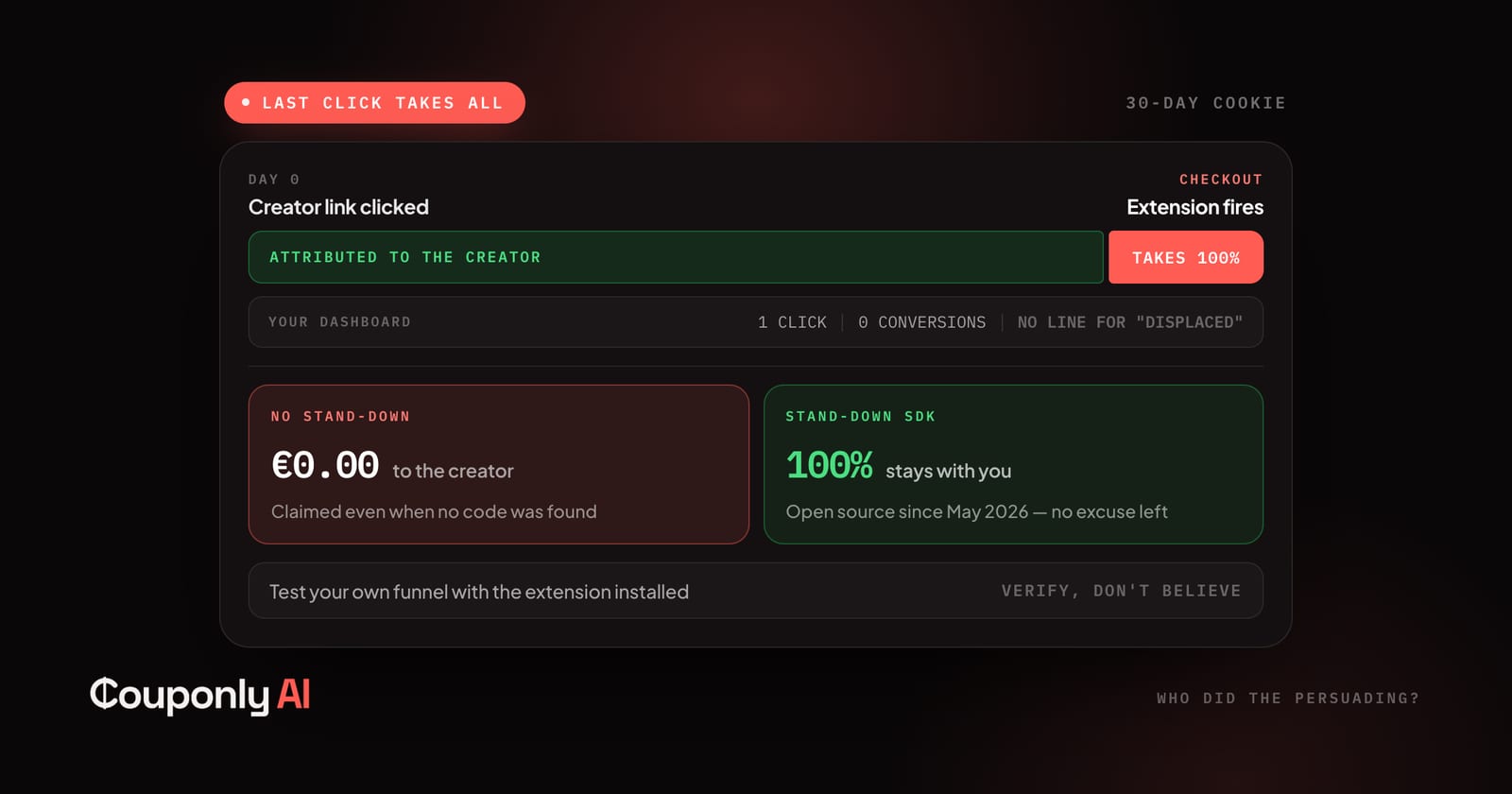
What Creators Should Know About Attribution
You sent the customer. Someone else got paid. Here's the mechanism, what the 2026 enforcement changed, and what to check on your own links.
Couponly Editorial
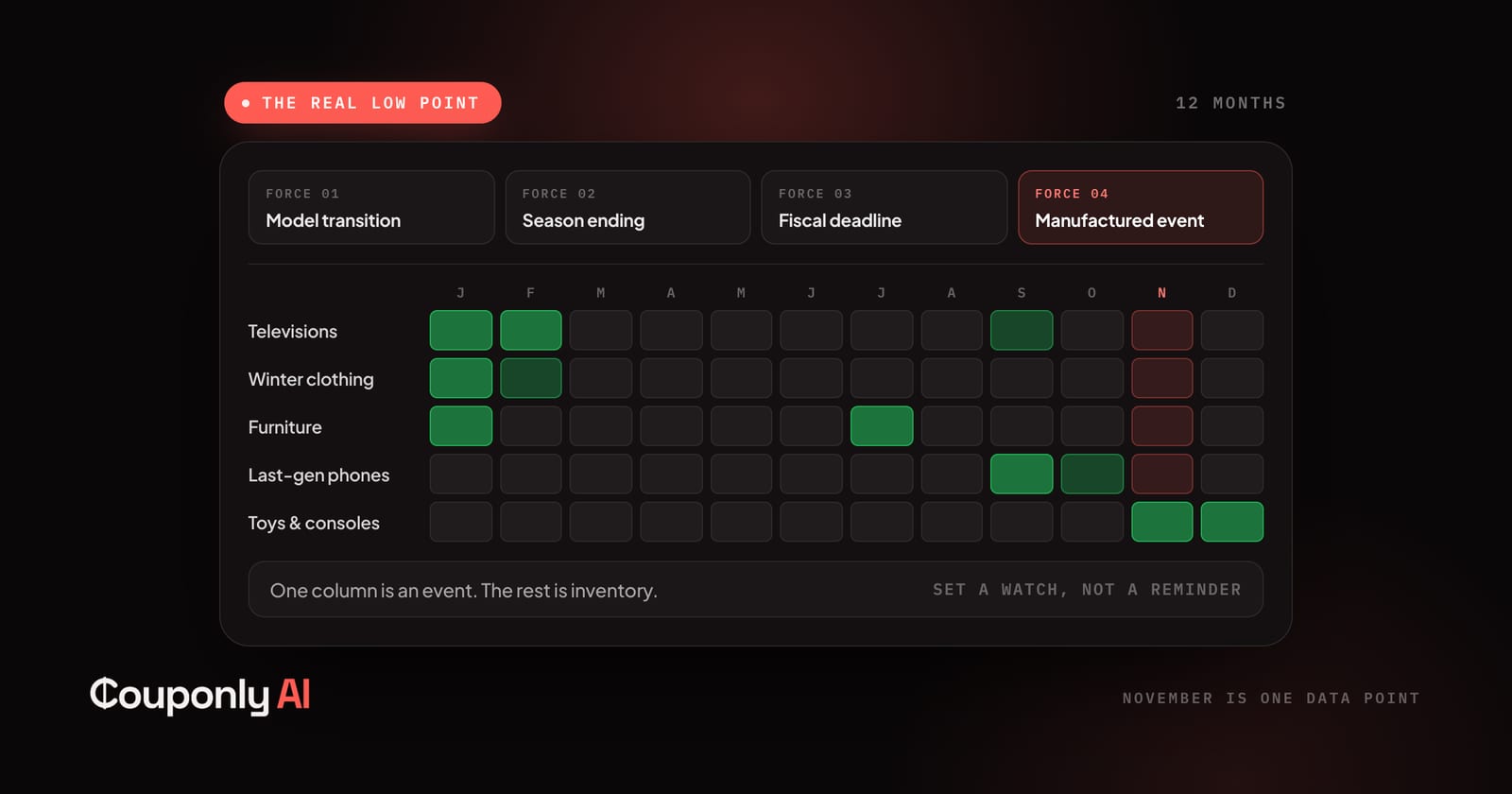
The Discount Calendar: When Things Go on Sale
Sale events are marketing. Product cycles and season endings are structural — and they're what actually move prices. Here's the calendar month by month.
Couponly Editorial
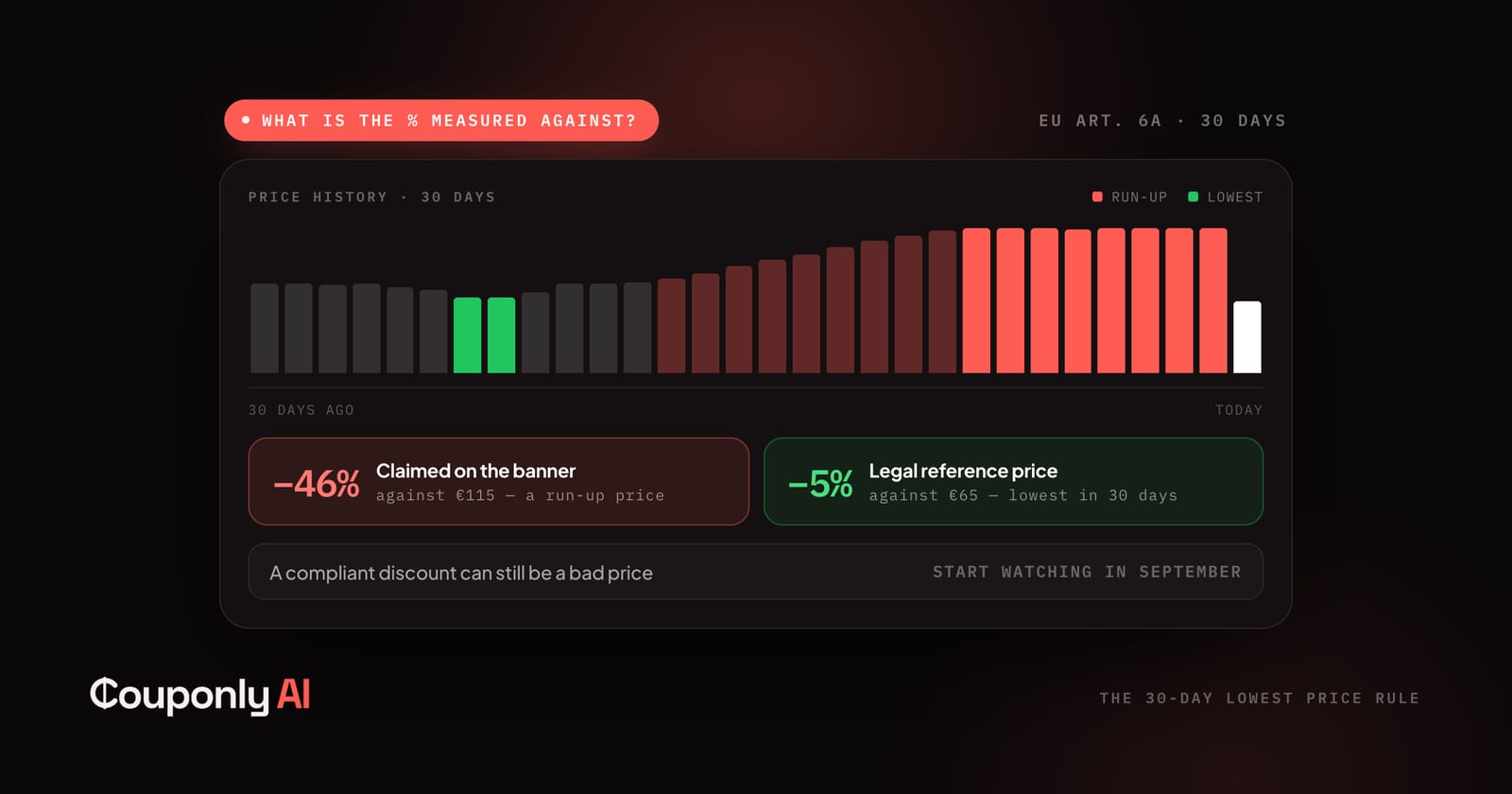
Black Friday: When the Discount Is Real
The oldest trick in retail is inflating a price so the discount looks bigger. EU law now bans it — here's what the rule covers and what it misses.
Couponly Editorial