
Black Friday: When the Discount Is Real
The oldest trick in retail is inflating a price so the discount looks bigger. EU law now bans it — here's what the rule covers and what it misses.

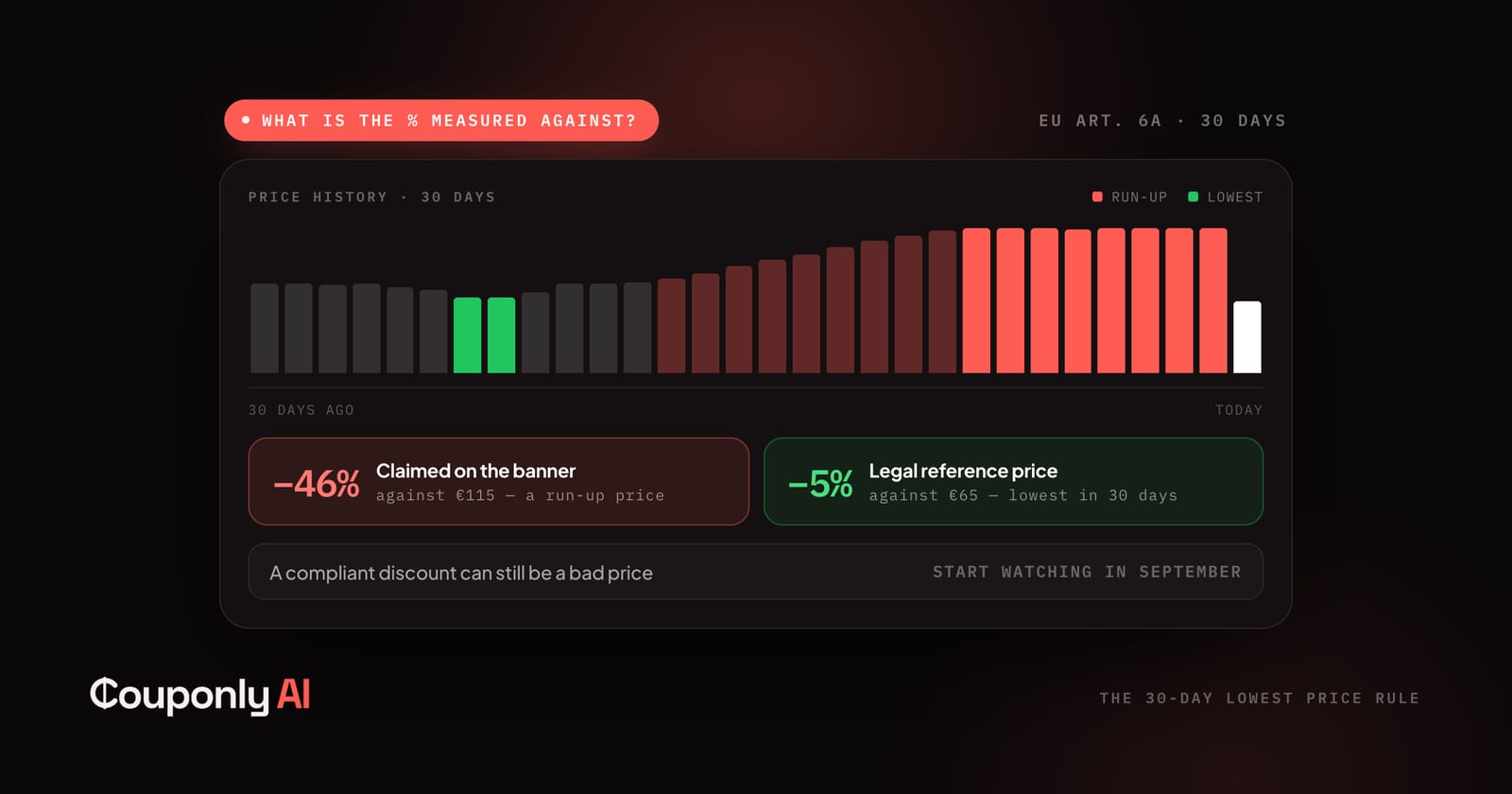
Every November the same argument runs: are the deals genuine, or are prices quietly raised in October so the markdown looks bigger?
Short answer: both happen, and in the EU the second one is now illegal. Since 2022, any advertised price reduction must be calculated against the lowest price the retailer charged in the previous 30 days — not against a made-up "original" price. Regulators have started fining companies over it, with penalties reaching tens of millions.
That changes what you should check. Not "is this a big percentage" but "what is this percentage measured against."
The trick the law was written to stop
Reference price inflation is straightforward: raise the price for a few weeks, then "discount" back to roughly what it always was. The customer sees −40%. The retailer gives up nothing.
It worked for decades because nobody could see price history. You had one data point — today's price — and a claim about the past you couldn't verify.
What EU law requires now
The Omnibus Directive (Directive (EU) 2019/2161) amended the older Price Indication Directive and added Article 6a. It entered into force on 28 May 2022.
The rule: when a trader announces a price reduction, the prior price shown must be the lowest price that trader applied during at least the 30 days before the reduction. The discount percentage has to be calculated from that figure.
A worked example. Say headphones sold at €80 three weeks ago, dropped to €65 in a flash sale ten days ago, and sat at €75 yesterday. The reference price for a new discount is €65 — the lowest in the window — not €80 and certainly not the manufacturer's suggested price.
Two details that matter more than they sound:
Successive campaigns don't reset the clock. Running "15% off every Sunday" or stacking Black Friday into Christmas doesn't let a retailer use the inflated between-sale price as the new baseline. Each reduction still references the lowest price in the preceding 30 days, including the reduced prices from earlier promotions.
Recommended retail price is not a reference price. A retailer can display an RRP, clearly labelled as such, but cannot use it to calculate or imply a discount unless it was genuinely their own previous price.
Enforcement is not theoretical
The rule sat quietly for a while. It doesn't any more:
France, July 2025 — the DGCCRF fined Shein €40 million for misleading commercial practices, including fake discounts created through prior price inflation.
Spain — the consumer ministry fined seven e-commerce companies for simulating promotions during Black Friday 2023 by raising prices before discounting them, totalling roughly €350,000.
Netherlands — the ACM has issued pre-campaign reminders to retailers about strict application of the 30-day rule, with fines and warnings already handed out.
Penalties have real ceilings. For cross-border infringements, member states must be able to impose fines of at least 4% of annual turnover in the affected countries, with a €2 million floor where turnover can't be determined.
What the rule does not cover
Knowing the gaps is what makes the rule useful to you.
Digital content and services. Article 6a applies to goods. Software subscriptions, streaming, and digital services sit outside it.
Business-to-business sales. Consumer protection only.
Perishables. Member states may set different rules for goods that spoil quickly.
Non-EU retailers selling to you from outside. Enforcement against a seller with no EU presence is considerably harder.
And crucially: it doesn't make the deal good. A retailer can comply perfectly and still offer you 10% off a product that's cheaper elsewhere at full price. Compliance is about honest arithmetic, not about value.
Outside the EU the picture is looser. The UK applies its own pricing practice rules; in the US, the FTC handles deceptive pricing under Section 5 of the FTC Act, with civil penalties per violation but no fixed 30-day reference window.
Four ways to check a deal yourself
1. Look for the 30-day price on the listing. In the EU it should be there. If a retailer shows a big percentage with no lowest-30-day figure, that's either a compliance failure or a discount measured against something that isn't a real prior price.
2. Check price history. Browser tools and price trackers show whether the "sale" price is genuinely unusual. This is the single fastest way to see reference inflation — a price that climbs in October and falls in November draws an obvious shape.
3. Compare across retailers, not against the "was" price. The relevant comparison is what someone else charges today, not what this seller claims to have charged before.
4. Start watching in September. You can't evaluate a November price without an October baseline. Anything you're seriously considering, note the price now.
That last one is the whole reason this article is published in September rather than November. Our extension has price watches for exactly this — set one now and you'll know in November whether the discount is measured against something real. It's the one feature that needs a sign-in, because it has to reach you by email.
When Black Friday discounts genuinely are real
Not all of it is theatre. Several things produce honest markdowns:
Model transitions. When a new version ships, the outgoing one gets cleared properly. This is where the largest genuine discounts in electronics and appliances live, and it's timing-driven rather than event-driven.
Actual overstock. Retailers who bought badly need the warehouse space before year-end. Deep, real, and usually limited to specific SKUs rather than whole categories.
Competitive matching on flagship items. A handful of headline products get priced aggressively to draw traffic. These are real, they're loss leaders, and they sell out fast — which is why the stock is limited.
Own-brand and platform promotions. When a retailer discounts its own products, there's no manufacturer margin floor to respect.
What tends not to be real: broad "up to 70% off" category banners, where the 70% applies to two clearance items and the rest sits at 10%.
The timing nobody tells you
Black Friday is not when everything is cheapest. Rough patterns worth knowing:
Category | Usually cheapest |
|---|---|
TVs | Late January to February, after new models are announced |
Laptops | Back-to-school in August, and model transitions |
Winter clothing | January, after the season |
Summer clothing | Late August |
Furniture | January and July clearance |
Mattresses | Public holiday weekends year-round |
Toys | Genuinely Black Friday and early December |
Kitchen appliances | Black Friday and Prime-style events |
The useful conclusion is not "never buy on Black Friday." It's that for anything you don't need immediately, the event is one data point in a year of prices rather than the finish line.
What codes do and don't add
A promo code on top of a sale price is often blocked — sale and clearance items are among the most common exclusions, which is one of the reasons codes get rejected. During major sale events this gets stricter, not looser, because the margin is already gone.
Two things follow. Compare the sale price against the code price rather than assuming they stack. And treat "verified" badges on seasonal codes with extra suspicion, because volume is high and most listings aren't tested — what that word actually means is worth two minutes.
You can see what's currently live at a given retailer in the store directory, and current offers on today's deals.
The short version
The law now forces the "was" price to mean something in the EU, and regulators are enforcing it with real fines. That removes the crudest version of the trick but leaves everything else: percentage banners measured against nothing in particular, exclusions that void codes, and the general fact that a compliant discount can still be a bad price.
So the check is unchanged in spirit and easier in practice. Find out what the thing actually costs on a normal day. Everything else is a claim about that number.
Frequently asked questions
Are Black Friday discounts real?
Some are, some aren't. Genuine markdowns cluster around model transitions, real overstock, and a small number of loss-leader flagship items. Broad "up to X% off" banners are usually driven by a handful of clearance products. In the EU, retailers must now calculate any advertised reduction against the lowest price they charged in the previous 30 days, which removes the crudest form of fake discounting.
What is the 30-day lowest price rule?
It comes from the EU Omnibus Directive (Directive (EU) 2019/2161), which added Article 6a to the Price Indication Directive and took effect on 28 May 2022. When a trader announces a price reduction, the prior price displayed must be the lowest price that trader applied during at least the 30 days before the reduction, and the discount percentage must be calculated from that figure.
Do retailers raise prices before Black Friday?
It has been a documented practice, and regulators have acted on it. Spain fined seven e-commerce companies for simulating promotions during Black Friday 2023 by raising prices beforehand, and France fined Shein €40 million in July 2025 for misleading practices including discounts created through prior price inflation.
Does the 30-day rule apply to everything?
No. It applies to goods sold to consumers. Digital content and services fall outside it, as do business-to-business sales, and member states may set different rules for perishable goods. It also doesn't apply to retailers operating outside the EU without an EU presence, where enforcement is much harder.
Can you use a promo code on Black Friday deals?
Often not. Sale and clearance items are among the most common exclusions from promotional codes, and restrictions typically tighten during major sale events because the margin has already been discounted. Compare the sale price against the code price rather than assuming they combine.
When is the best time to buy, if not Black Friday?
It depends on the category. TVs are usually cheapest in late January or February after new models are announced; winter clothing in January; furniture in January and July; laptops around back-to-school and model transitions. Toys and kitchen appliances are among the categories where Black Friday genuinely is the low point.
Keep reading
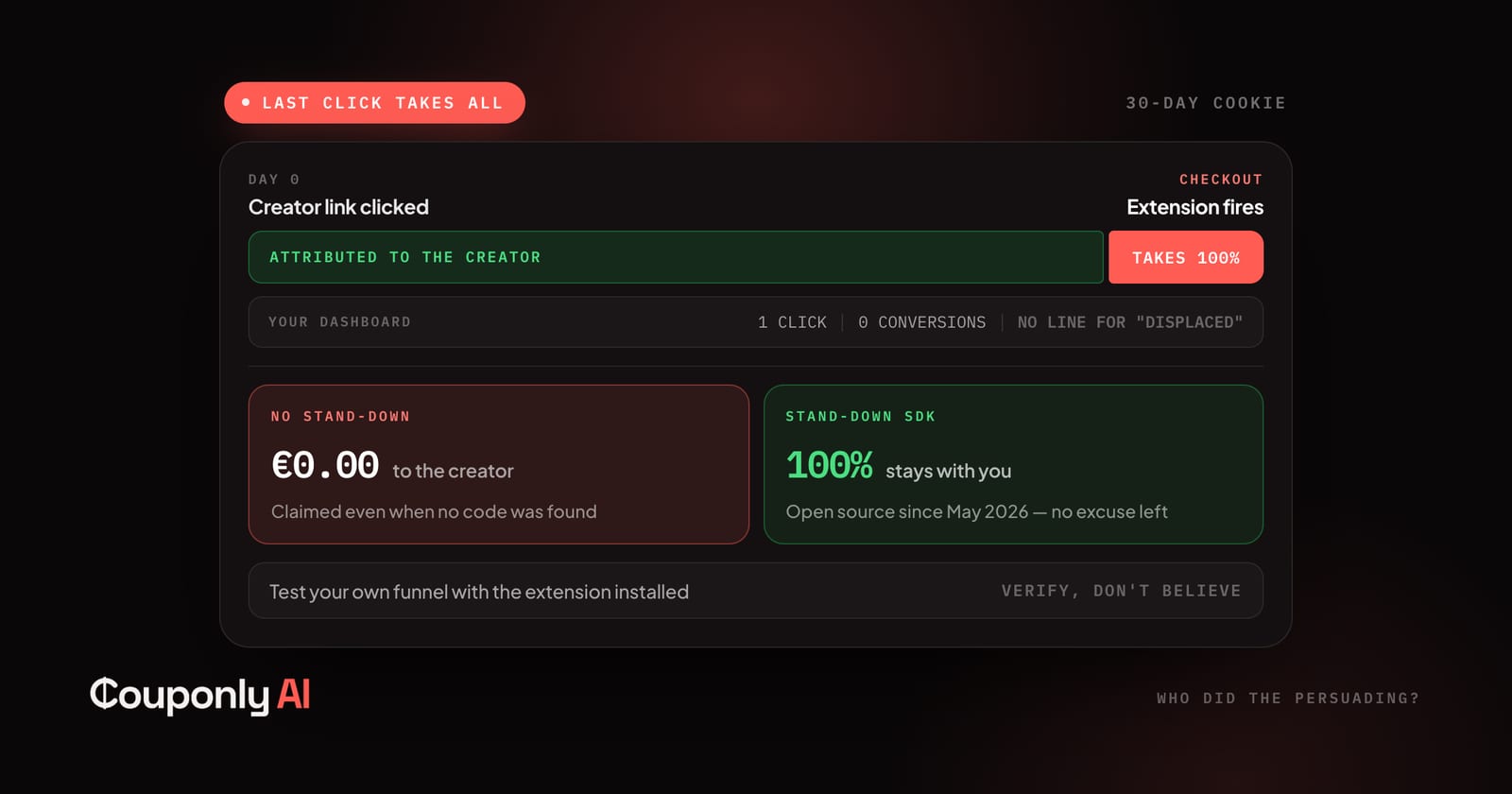
What Creators Should Know About Attribution
You sent the customer. Someone else got paid. Here's the mechanism, what the 2026 enforcement changed, and what to check on your own links.
Couponly Editorial
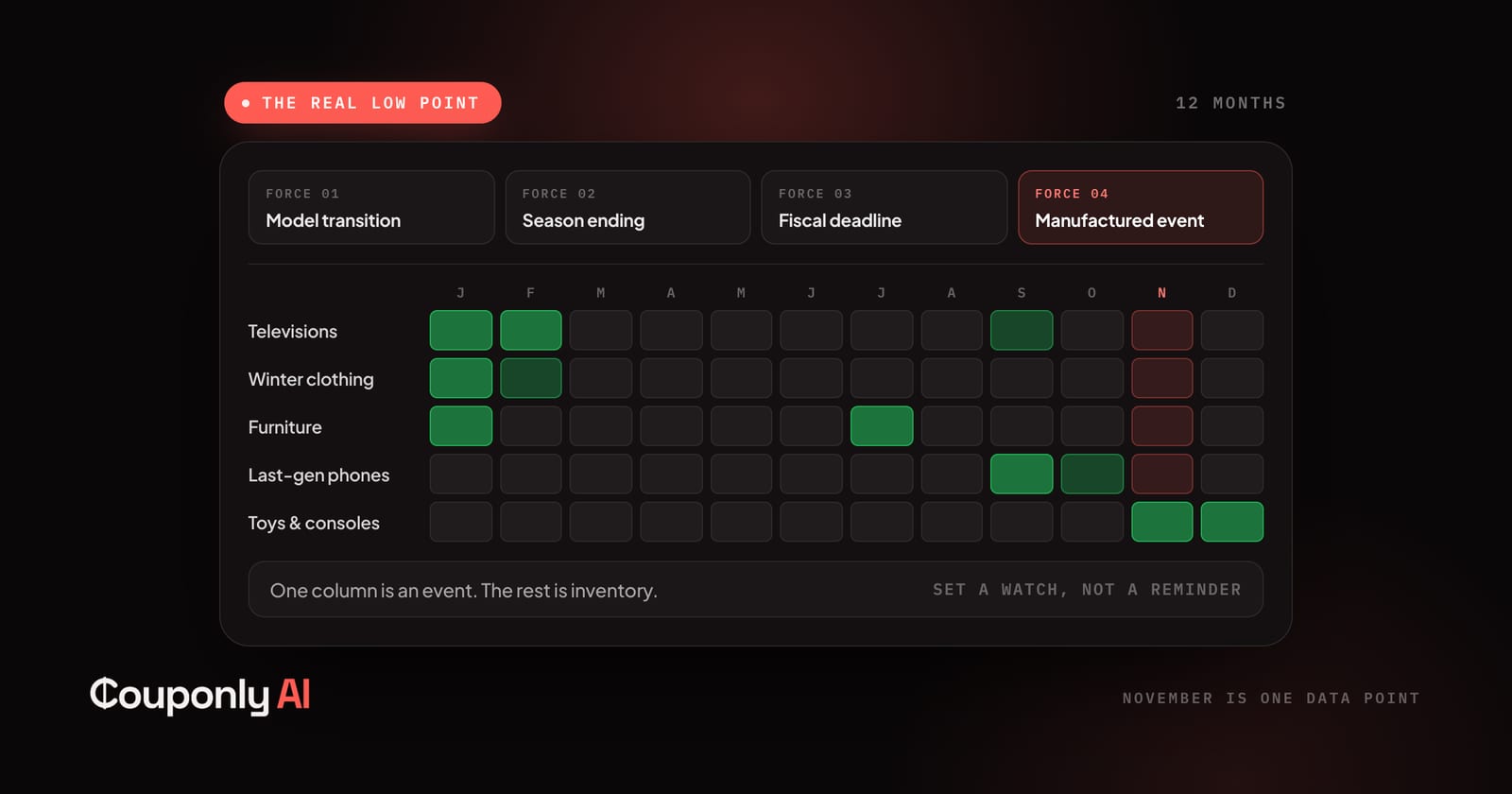
The Discount Calendar: When Things Go on Sale
Sale events are marketing. Product cycles and season endings are structural — and they're what actually move prices. Here's the calendar month by month.
Couponly Editorial
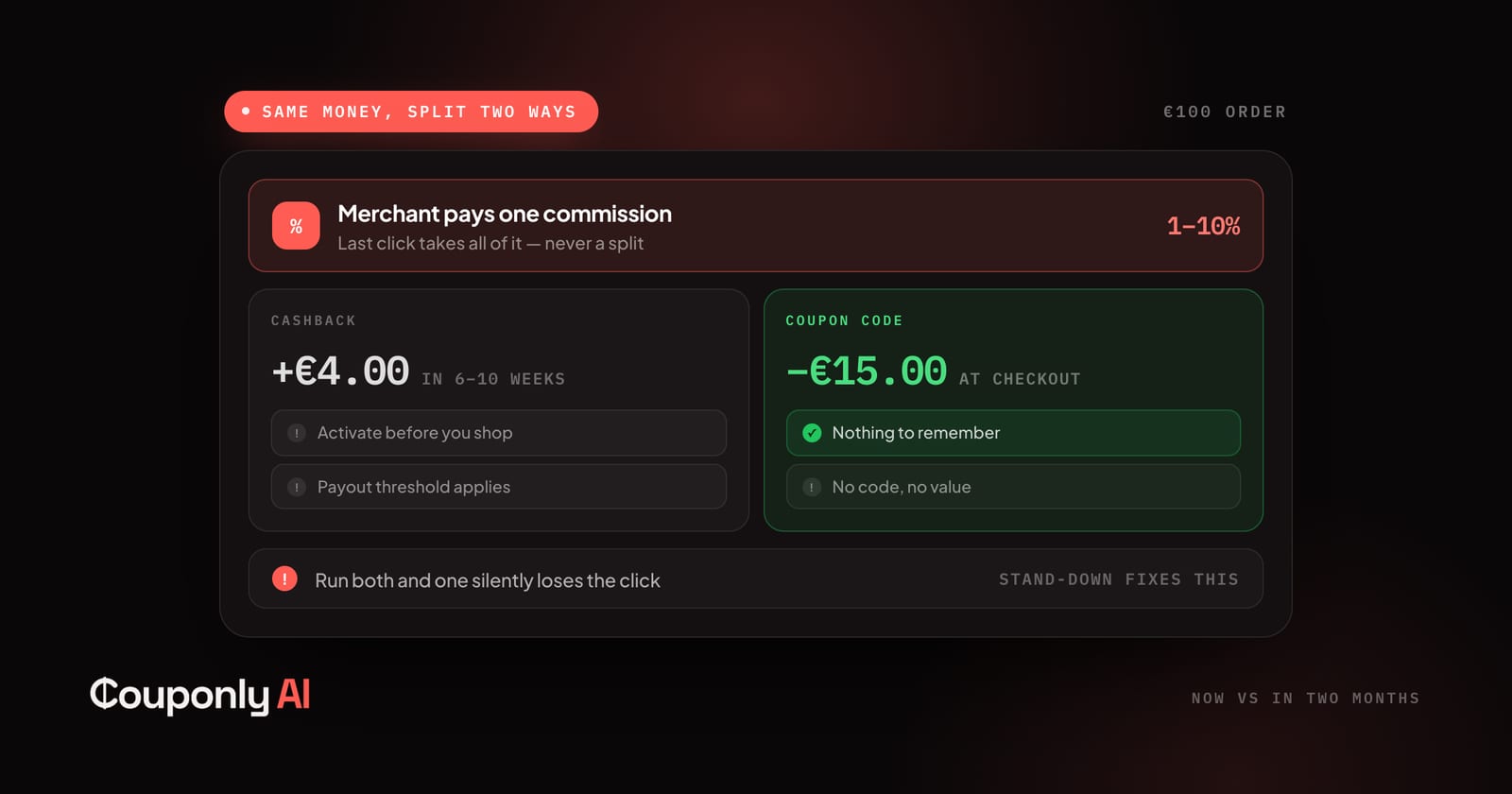
Cashback vs Coupon Extensions: Which Wins?
They're funded by the same money and they compete for it. Here's how each model works, why they usually can't both win, and which one fits how you shop.
Couponly Editorial