
The Discount Calendar: When Things Go on Sale
Sale events are marketing. Product cycles and season endings are structural — and they're what actually move prices. Here's the calendar month by month.

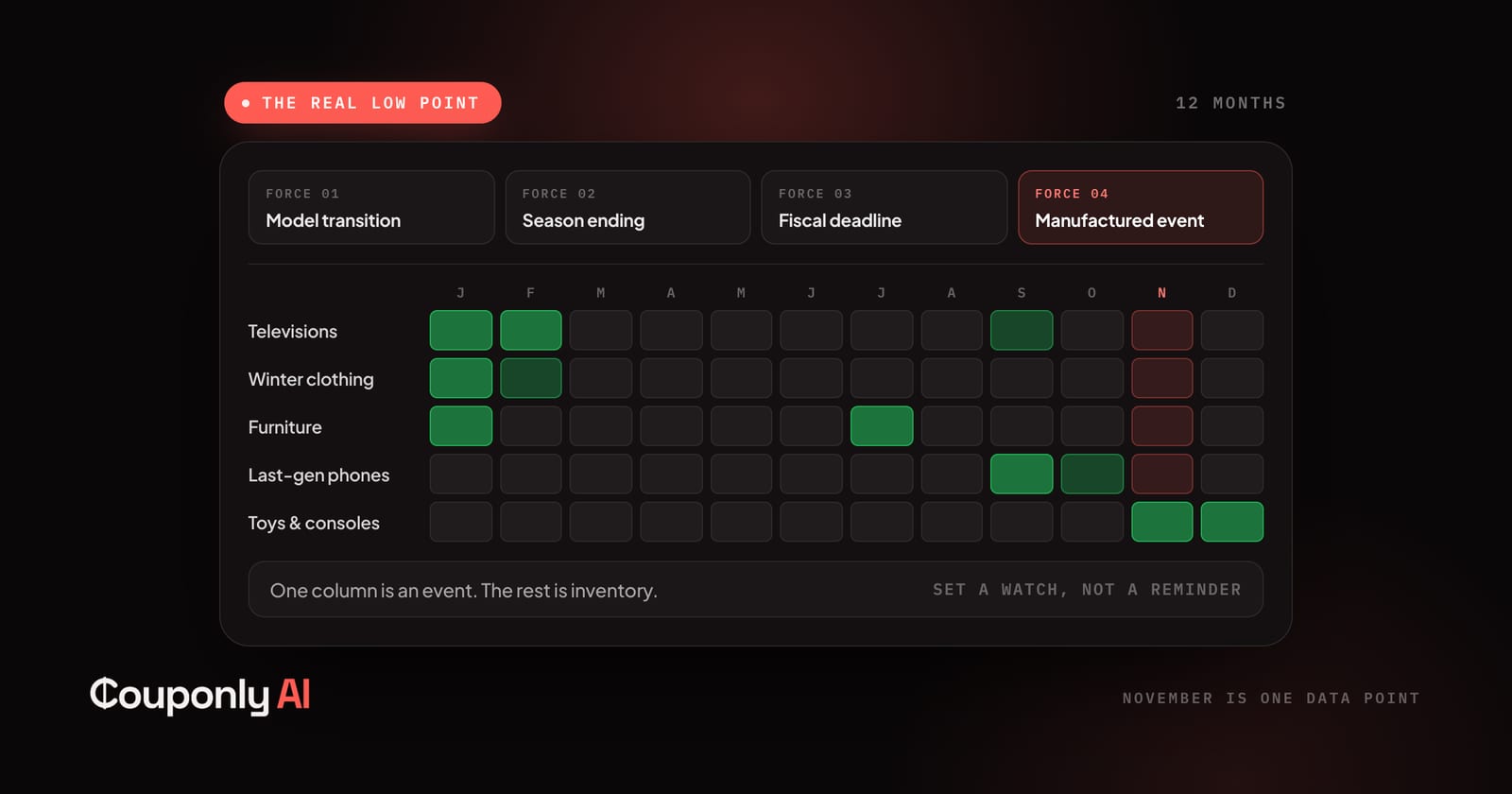
Retail sale events are scheduled by marketing departments. Product prices are moved by something else — inventory that has to clear, and models that have to be replaced.
Short answer: most categories have a predictable annual low point, and for many of them it isn't Black Friday. TVs bottom out in late winter after new models are announced. Winter clothing is cheapest in January. Furniture clears in January and July. Knowing which force applies to what you're buying is worth more than knowing when the next sale is.
Here's the calendar, and the reasoning underneath it so you can apply it to things not on the list.
Four forces that actually move prices
Everything below comes from one of these. Events are only the fourth.
1. Model transitions. When a manufacturer announces a replacement, the outgoing model has to clear. This produces the deepest genuine discounts in electronics and appliances, and it's driven by announcement dates rather than by the calendar.
2. Season endings. Retailers pay to store what didn't sell. Anything seasonal gets marked down hard once its season is over — which is why coats are cheapest when you least want to buy one.
3. Fiscal and inventory deadlines. Quarter ends and financial year ends push clearance. This varies by market and by company, so it's less predictable than the first two, but it's real.
4. Manufactured events. Black Friday, Cyber Monday, Singles' Day, mid-summer sales. These generate volume, and some genuine loss-leaders, but the discount is usually shallower than the first three forces produce. We went through how to tell in when the Black Friday discount is real.
The useful move is to ask which force applies. If a category's low point is driven by a model cycle, waiting for an event is the wrong strategy entirely.
Month by month
Month | Genuinely cheapest |
|---|---|
January | TVs (new models announced), winter clothing, furniture, fitness equipment, bedding, Christmas decorations |
February | TVs (last year's models clearing), mattresses, home audio, chocolate after mid-month |
March | Winter sports gear, luggage, small kitchen appliances, frozen food |
April | Vacuum cleaners, spring cleaning supplies, gardening tools early in season |
May | Mattresses, home appliances, athletic wear, outdoor furniture early season |
June | Gym memberships, tools, men's clothing, summer season starting to discount |
July | Furniture (mid-year clearance), summer clothing, outdoor gear, older-model laptops |
August | Laptops and school electronics, backpacks, summer clothing clearance, outdoor furniture |
September | Older-model phones (after flagship announcements), bicycles, gardening equipment, mattresses |
October | Jeans, air conditioners, outdoor equipment, early Black Friday pricing on some electronics |
November | Toys, kitchen appliances, headphones, game consoles and bundles |
December | Toys after mid-month, gift cards, cookware, anything cleared after the 26th |
Two caveats before you use it. This calendar is skewed toward the northern hemisphere for anything seasonal — flip the clothing and outdoor entries below the equator. And it's shaped by the US and Western European retail calendar, so local sale periods in your market (winter and summer sales are regulated in some countries) can override it.
The categories worth understanding properly
Televisions and large electronics
The cycle is announcement-driven. New model lines are announced early in the year and reach shops in spring, which means the previous generation clears in late January through February — and again more quietly in September, when retailers make room for the holiday range. Current offers are on the TV & home theater and audio & headphones pages.
Black Friday TV pricing is real but it's usually on models built for the event: specification-reduced variants that exist to hit a price point. Compare model numbers, not screen sizes.
Clothing
Pure season logic. Winter clothing bottoms out in January, summer clothing in late August. The deepest reductions come after the main clearance, when what's left is broken sizes — which is fine if your size is still there and useless if it isn't.
Jeans are the odd one out: October is consistently strong, a leftover from the back-to-school cycle.
By department: women's clothing, men's clothing, kids' clothing, shoes and sneakers, outdoor apparel. Gymshark and other activewear retailers follow the same season logic.
Furniture and mattresses
Furniture clears twice: January and July, aligned with the two main showroom refresh cycles. New collections arrive in February and August, so the month before each is when the outgoing range moves.
Mattresses are different — they discount around holiday weekends throughout the year rather than having a single low point. If you're buying a mattress, the next long weekend is roughly as good as any other.
See furniture, mattresses & bedding, patio & outdoor furniture and home decor.
Laptops and phones
Laptops follow back-to-school in August, plus model transitions that vary by manufacturer.
Phones follow flagship announcements. The reliable pattern is that the previous flagship drops sharply within weeks of a new one being announced, typically September onwards for the largest brands. Buying one generation behind, one month after the announcement, is close to the best value in consumer electronics.
Relevant pages: computers & laptops, phones & accessories, tablets & e-readers, and refurbished electronics, which is where model-transition stock often ends up. Marketplaces like Amazon and eBay tend to move first on last-generation pricing.
Appliances
Large appliances discount on holiday weekends and around Black Friday, and there's a genuine clearance in September and October as new model years arrive. Small kitchen appliances are strongest in November and December, driven by gifting rather than inventory.
See appliances, kitchen & dining and cookware & bakeware. Department stores such as Walmart run the deepest event pricing here.
Toys, gifts and the November exception
This is the one block where the manufactured event genuinely is the low point. Toys & games, board games & puzzles, gaming hardware and video games all bottom out in November and again after 26 December.
Two adjacent categories worth knowing: winter sports gear clears hard in March, and bags & luggage is cheapest in March and again in late summer, well outside any sale event. Handmade and small-batch sellers on Etsy follow gifting demand rather than inventory cycles, so their pricing runs on a different clock entirely.
What the calendar doesn't tell you
Whether the specific retailer is competitive. A category being in season for discounts doesn't mean the shop you're on has the best price. Cross-retailer comparison beats calendar timing.
Whether a code will stack. Sale and clearance items are among the most common exclusions, so the deepest calendar discounts are often the ones a promo code won't touch. That's one of the seven reasons codes get rejected.
Whether stock will still exist. End-of-season pricing on broken sizes and discontinued colours is real, and it disappears. Waiting has a cost.
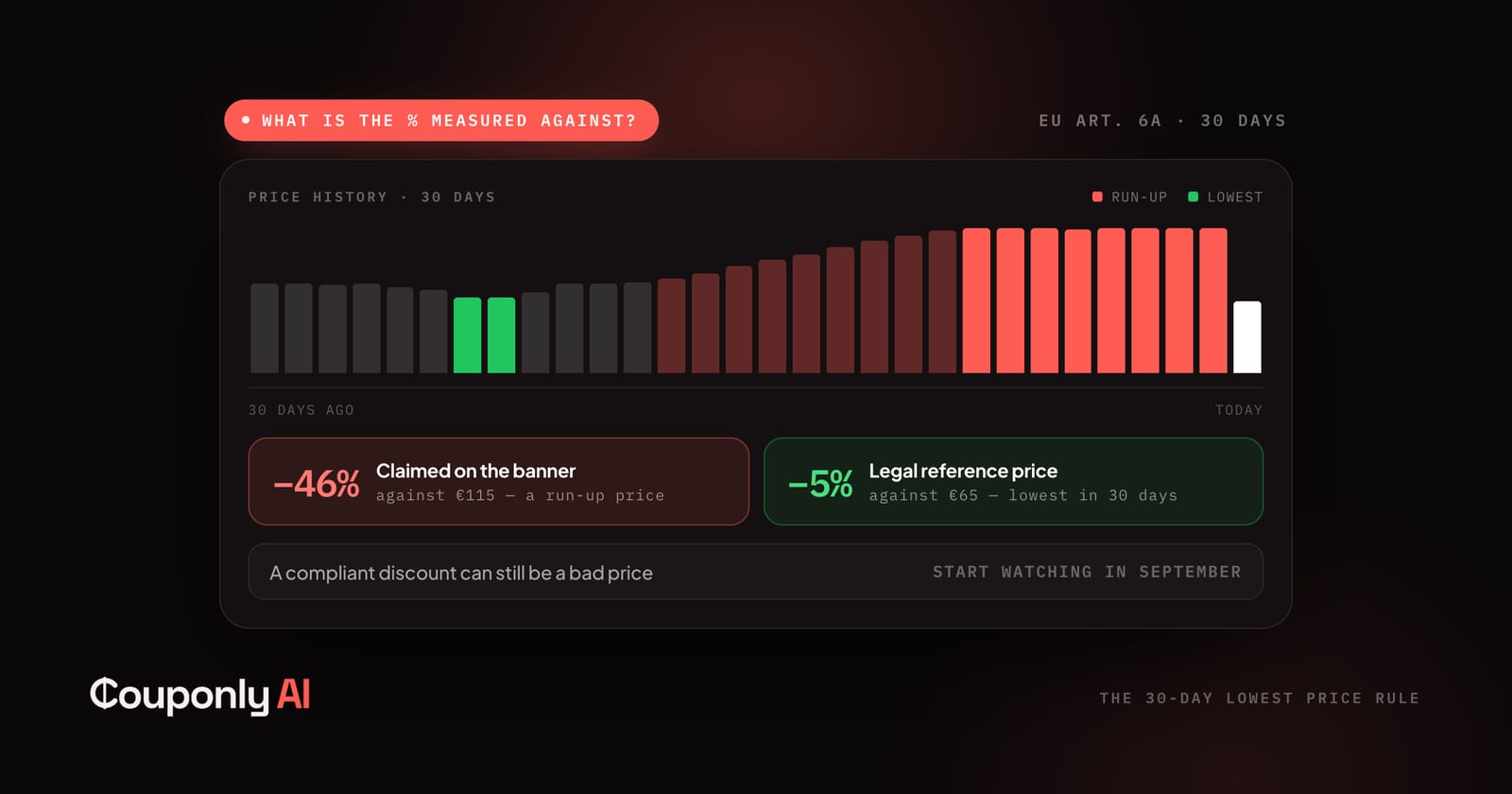
What the price actually was before. A calendar tells you when to look; it doesn't verify the discount you find. In the EU, the "was" price must be the lowest of the previous 30 days — the mechanics are in the Black Friday article.
How to actually use this
Pick the force, then the month. If you're buying something with a model cycle, wait for the transition rather than for an event. If it's seasonal, wait for the season to end. If it's neither — most household goods, most groceries — the calendar barely applies and you're better off comparing retailers today.
Set a watch instead of a reminder. The failure mode with calendar shopping isn't picking the wrong month; it's forgetting to look. Our extension has price watches for this, and they're the one feature that needs a sign-in, because an alert has to reach you somehow.
Check what's live now. Some of what's above is running today. The store directory and category pages show current offers, and today's deals is the shortlist.
The honest summary
Sale events exist to concentrate demand into a weekend. Product cycles and season endings exist because inventory costs money to hold. The second pair moves prices further and more reliably than the first, and it does so on a schedule nobody advertises — which is exactly why it's worth knowing.
For anything you don't need this week, the question isn't "is there a sale on." It's "what has to happen for this to get cheaper, and when does that happen."
Frequently asked questions
When is the best time to buy a TV?
Late January through February, after new model lines are announced and the previous generation clears. There's a second, quieter window in September as retailers make room for the holiday range. Black Friday TV pricing is real but often applies to specification-reduced models built for the event, so compare model numbers rather than screen sizes.
Is Black Friday actually the cheapest time to buy?
For some categories yes — toys, kitchen appliances, headphones and console bundles genuinely bottom out in November. For many others no. TVs, winter clothing, furniture and last-generation phones all reach their real low points at other times, driven by model transitions and season endings rather than by the event.
When is clothing cheapest?
At the end of its season. Winter clothing bottoms out in January, summer clothing in late August. The deepest reductions come after the main clearance, when remaining stock is broken sizes — good if your size survived, useless if it didn't. Jeans are an exception, with October consistently strong.
When do furniture prices drop?
January and July, aligned with the two main showroom refresh cycles. New collections arrive in February and August, so the outgoing range clears in the month before each. Mattresses follow a different pattern, discounting around holiday weekends throughout the year rather than at a single annual low point.
When is the best time to buy a phone?
Shortly after a new flagship is announced, when the previous generation drops sharply — typically September onwards for the largest brands. Buying one generation behind, roughly a month after the announcement, is among the best value available in consumer electronics.
Do promo codes work on seasonal sale prices?
Often not. Sale and clearance items are among the most common exclusions from promotional codes, and restrictions tend to tighten during major discount periods because the margin has already been given up. Compare the sale price against the code price rather than assuming they combine.
Keep reading
What Creators Should Know About Attribution
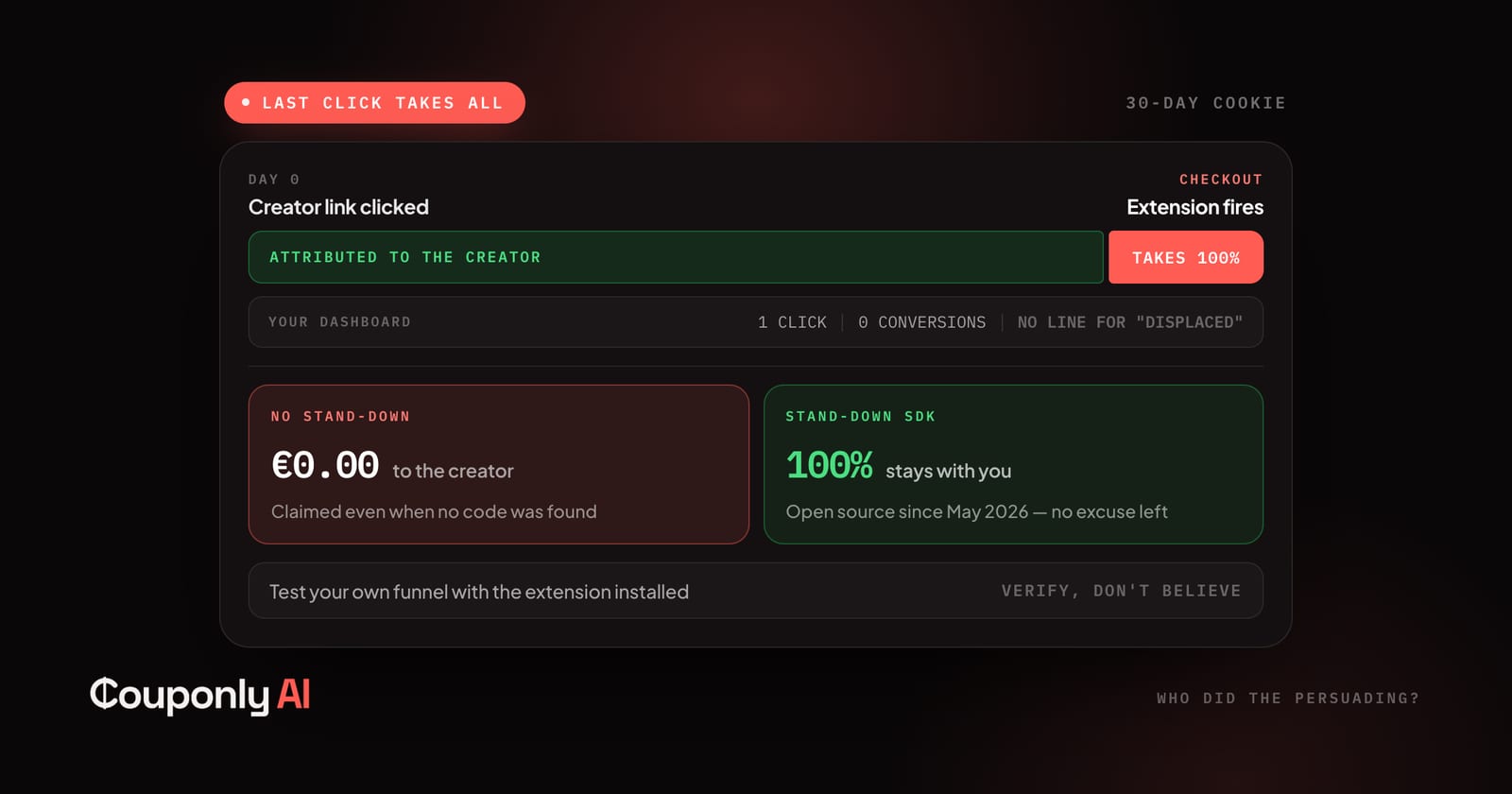
You sent the customer. Someone else got paid. Here's the mechanism, what the 2026 enforcement changed, and what to check on your own links.
Couponly Editorial
Black Friday: When the Discount Is Real
The oldest trick in retail is inflating a price so the discount looks bigger. EU law now bans it — here's what the rule covers and what it misses.
Couponly Editorial
Cashback vs Coupon Extensions: Which Wins?
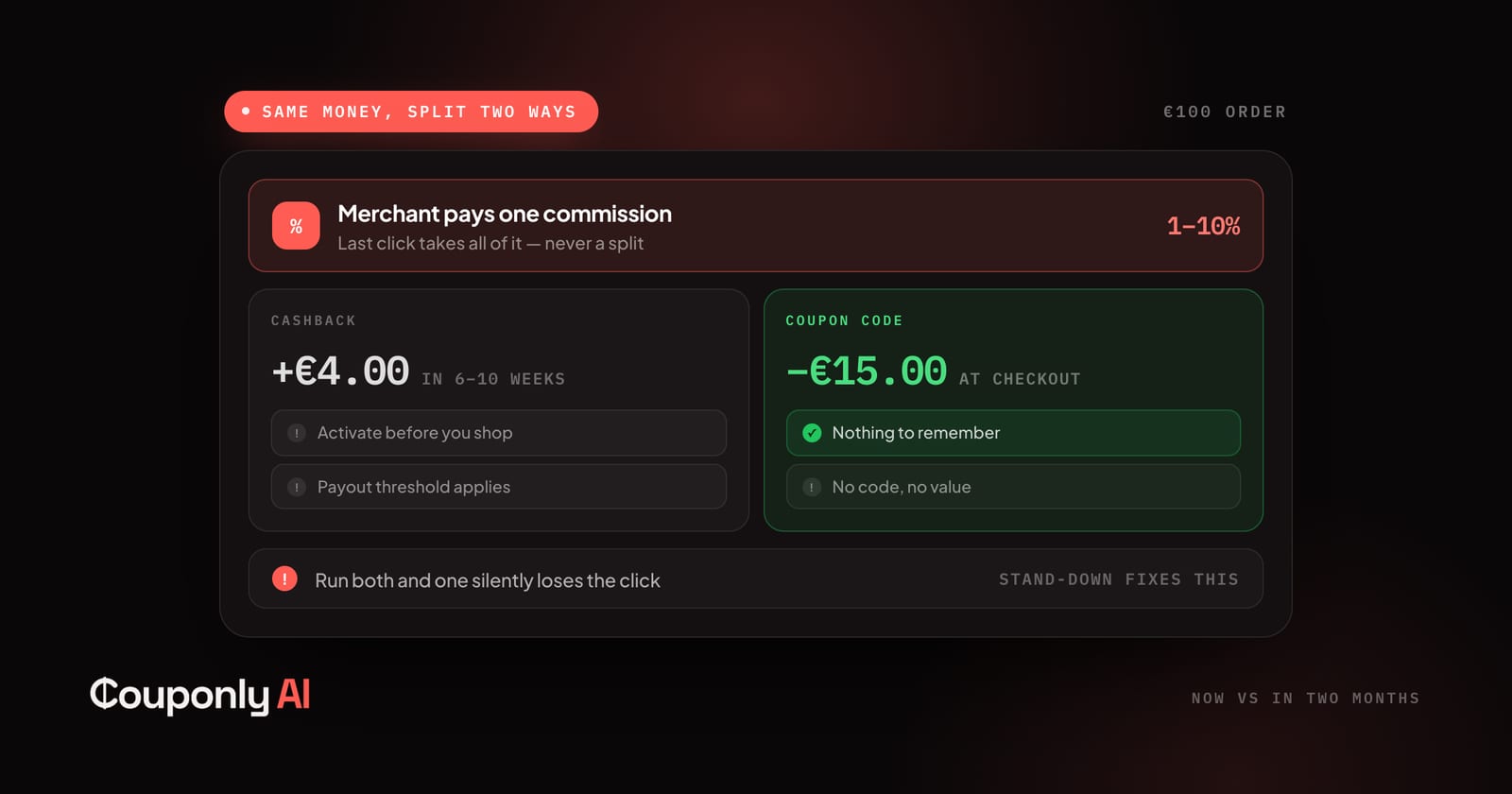
They're funded by the same money and they compete for it. Here's how each model works, why they usually can't both win, and which one fits how you shop.
Couponly Editorial