
What "verified" actually means on a coupon site
The word is on almost every coupon listing, and on most of them it means nothing at all. Here's what testing a code actually requires — and what no one can promise you.

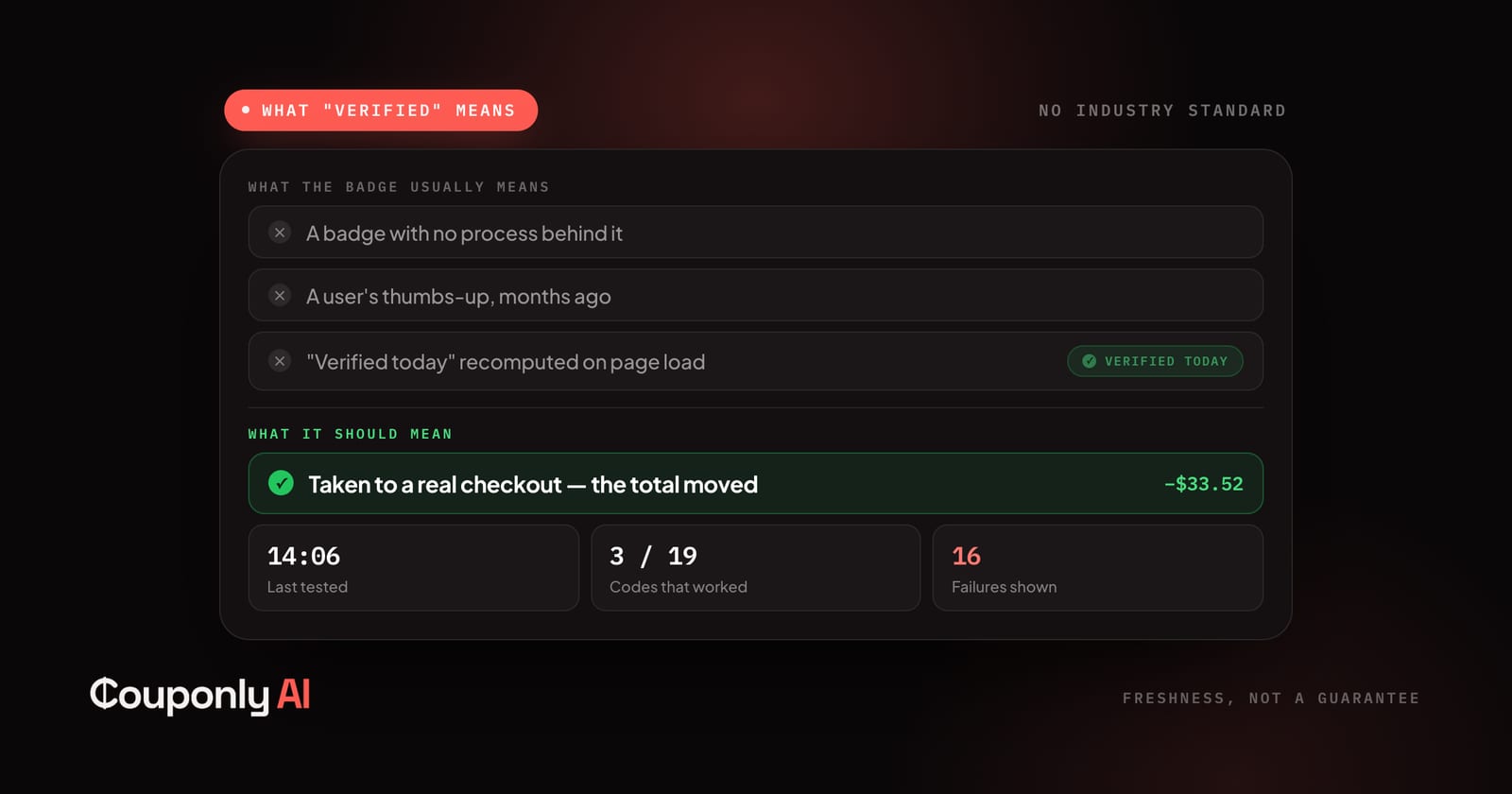
Look at almost any coupon listing and you'll see a badge: Verified. Sometimes with a checkmark, sometimes with a date. It's the single most common word in this industry and one of the least meaningful.
Short answer: on most sites it means a human or a script confirmed the code exists somewhere, or that a user clicked a thumbs-up at some point. Very few sites take a code to an actual checkout and observe whether the total changes. The word is doing marketing work, not information work — and the difference is why you keep pasting codes that don't apply.
Here's what the word can legitimately mean, what it can never mean, and the question that separates the two.
The model most coupon sites still run on
The coupon site as a format is about twenty-five years old, and the underlying mechanism has barely changed: users submit codes, the site lists them, other users vote on whether they worked.
That design made sense when it was invented. It doesn't need engineering, it scales for free, and the crowd surfaces good codes quickly. It also has three structural problems that no amount of interface polish fixes:
Nothing tells the system a code died. Codes don't expire loudly. They stop working silently, at a moment the merchant chooses. A listing has no signal unless a user bothers to come back and report failure — and almost nobody does. They just close the tab.
Success votes measure the wrong thing. A code that worked for someone with a €200 cart in Germany tells you nothing about your €40 cart in Estonia. The vote records that it worked for them, under conditions nobody logged.
The incentive runs backwards. A page listing forty offers ranks better than one listing four. Removing dead codes shrinks the page and costs traffic. So the rational move for a traffic-funded coupon site is to leave expired codes up — which is exactly what most of them do. If you've wondered why so many codes fail, this is the largest single reason.
What "verified" usually means in practice
There's no standard, so the word gets stretched. In rough order of how common they are:
Nothing at all. A visual badge with no process behind it.
The code exists. It was scraped from a merchant email or a partner feed, so it was real at some point.
A user said so. The most recent thumbs-up, sometimes months old.
A date was written. "Verified today" recalculated automatically on page load, describing when the page rendered rather than when anything was checked.
Syntax was checked. The code matches the format the merchant uses. Says nothing about validity.
Only the last category — actually attempting the code at a checkout and observing the result — is verification in the sense the word implies. It's rare because it's genuinely hard.
What testing a code actually requires
The reason most sites don't do it isn't laziness. It's that the work scales badly.
You have to reach a checkout. Not the product page — the actual cart step where the discount field lives. That means adding an item, handling any regional or currency prompt, and getting far enough to submit a code.
Every store is built differently. The discount field has a different name, position, and behaviour on every platform, and often between merchants on the same platform. Some apply on Enter, some need a button, some validate asynchronously and update the total two seconds later.
Failure is ambiguous. A rejected code might be expired, might be excluded by cart contents, might be new-customers-only. A test that only records pass/fail loses information you'd want.
And it all changes. Merchants redesign checkouts. A scraper written against last year's layout silently stops working, and a system that doesn't notice starts reporting confident nonsense.
Multiply that across tens of thousands of retailers, repeatedly, and you have an engineering problem rather than a content problem. That's the actual reason the industry defaulted to crowdsourcing.
Where AI genuinely helps — and where it doesn't
This is worth being unromantic about, because "AI-powered" is now as devalued a phrase as "verified."
It helps with the brittleness. The hard part of automated checkout testing was never the logic; it was that hand-written rules break the moment a store changes its layout. A system that can interpret a page it hasn't seen before, and find the discount field by understanding the page rather than matching a stored selector, survives redesigns that would break a scraper.
It helps with coverage. Finding candidate codes across merchant emails, social posts, and partner feeds, and deciding which are plausible enough to test, is pattern work at a scale no team does manually.
It does not conjure discounts. No system invents a code the merchant never issued. Anything claiming to generate working codes is either describing brute-force guessing — which merchants rate-limit and which mostly produces nothing — or lying.
It does not know your cart. Until you're at checkout with your specific items, no amount of prior testing knows whether a code applies to what you're buying. This is the limit that matters most, and it's why testing at the moment of checkout beats any pre-computed list.
That last point is what our browser extension exists for: our systems test codes continuously against real checkouts to keep the list honest, and then at your checkout the extension tests those codes against your cart and keeps whichever lowers the total most. The list narrows the field; your cart decides the winner.
The honest limits
We'd rather state these than let the badge imply more than it can carry.
Verified is a freshness signal, not a guarantee. It means our systems recently observed the code working. It doesn't mean it will work for you, because only the merchant controls eligibility and they can change it at any moment.
Recently isn't always. Between one test and the next, a code can die. Any system that tells you otherwise is describing marketing, not mechanics.
Some things can't be tested from outside. Account-specific and single-use codes may pass a test for one session and fail for everyone else. We filter what we can detect and won't pretend the filter is perfect.
Coverage isn't uniform. Some checkouts resist automation. Where we can't test properly, that's a gap, not a silent pass.
We put the same limits in writing on why you can trust Couponly — including the parts that constrain us — because a claim you can't check isn't worth making. The same goes for how we make money: a verification claim from a site that won't explain its revenue model is worth very little.
How to read a "verified" badge on any site
Four questions, in order of how much they tell you:
Is there a timestamp, and does it change? Reload the page. If "verified today" survives a reload on a page you visited last week, it's computed from the current date, not from a test.
Does the site say what verification means? A specific description of the process is a much better signal than a badge. Vagueness here is the tell.
Does it report failures? A site that only ever shows working codes isn't testing. Real testing produces a lot of negatives, and a system with nothing to hide will show success rates rather than a binary badge.
Does it explain how it makes money? Verification costs money to run. A site with no visible business model has no visible reason to pay for it.
Apply these to us as readily as to anyone else. If a code we've marked verified fails for you, that's worth knowing about — tell us, because a wrong badge is a bug in the system, not a rounding error.
To see what's currently live for a specific retailer, start from the store directory.
The same four questions, applied across the whole category, are in Honey alternatives in 2026.
Frequently asked questions
What does "verified" mean on a coupon site?
There's no industry standard, so it varies enormously. On most sites it means a code was scraped from somewhere, or that a user marked it as working at some point in the past. Only a minority of sites actually attempt the code at a checkout and observe whether the total changes.
Are verified coupon codes guaranteed to work?
No. Verification can only tell you a code was observed working recently. Merchants control eligibility and can change or end a promotion at any time, and a code may still fail because of your cart contents, your region, or a new-customer restriction.
Why do coupon sites list expired codes?
Because removing them costs traffic. A page listing many offers tends to rank better than one listing few, and there's usually no signal telling the site a code has died — users who hit a failure close the tab rather than reporting it.
How can coupon codes be tested automatically?
By taking a code to an actual checkout, applying it, and observing whether the total changes. The difficulty is that every store's checkout is built differently and layouts change often, which is why systems that interpret a page rather than matching stored rules hold up better over time.
Can AI generate working coupon codes?
No. No system can create a code the merchant never issued. Anything claiming to generate working codes is describing brute-force guessing, which merchants rate-limit and which rarely produces anything usable.
How can I tell if a coupon site's verification is real?
Reload the page and see whether the timestamp changes with the date rather than reflecting a test. Check whether the site describes its verification process specifically, whether it ever reports failures or success rates rather than only wins, and whether it explains how it makes money.
Keep reading
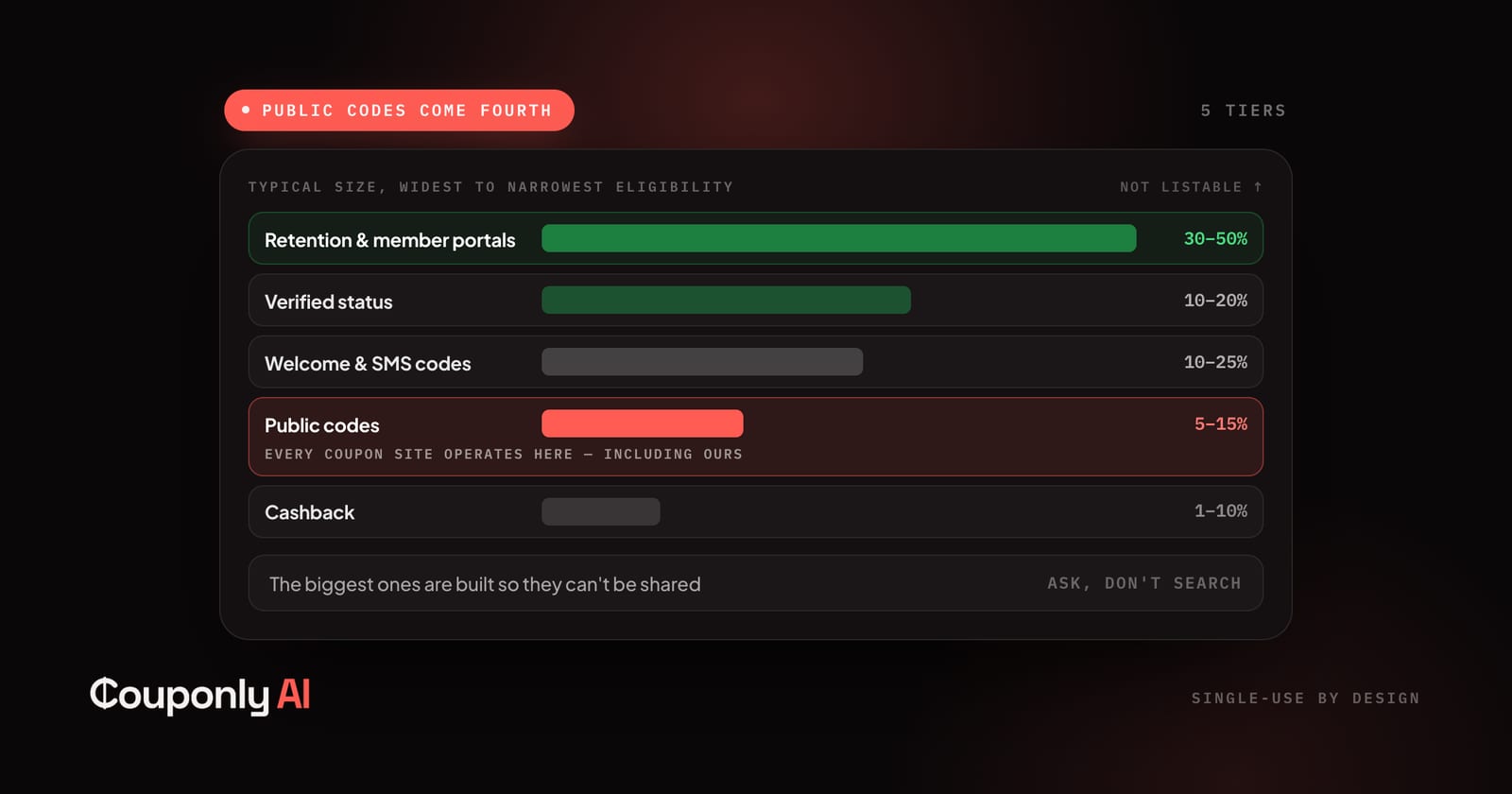
The Discounts That Never Get Listed
The largest discounts merchants issue never reach a coupon site, because they're built so they can't be shared. Here are nine, and how to get each.
Couponly Editorial
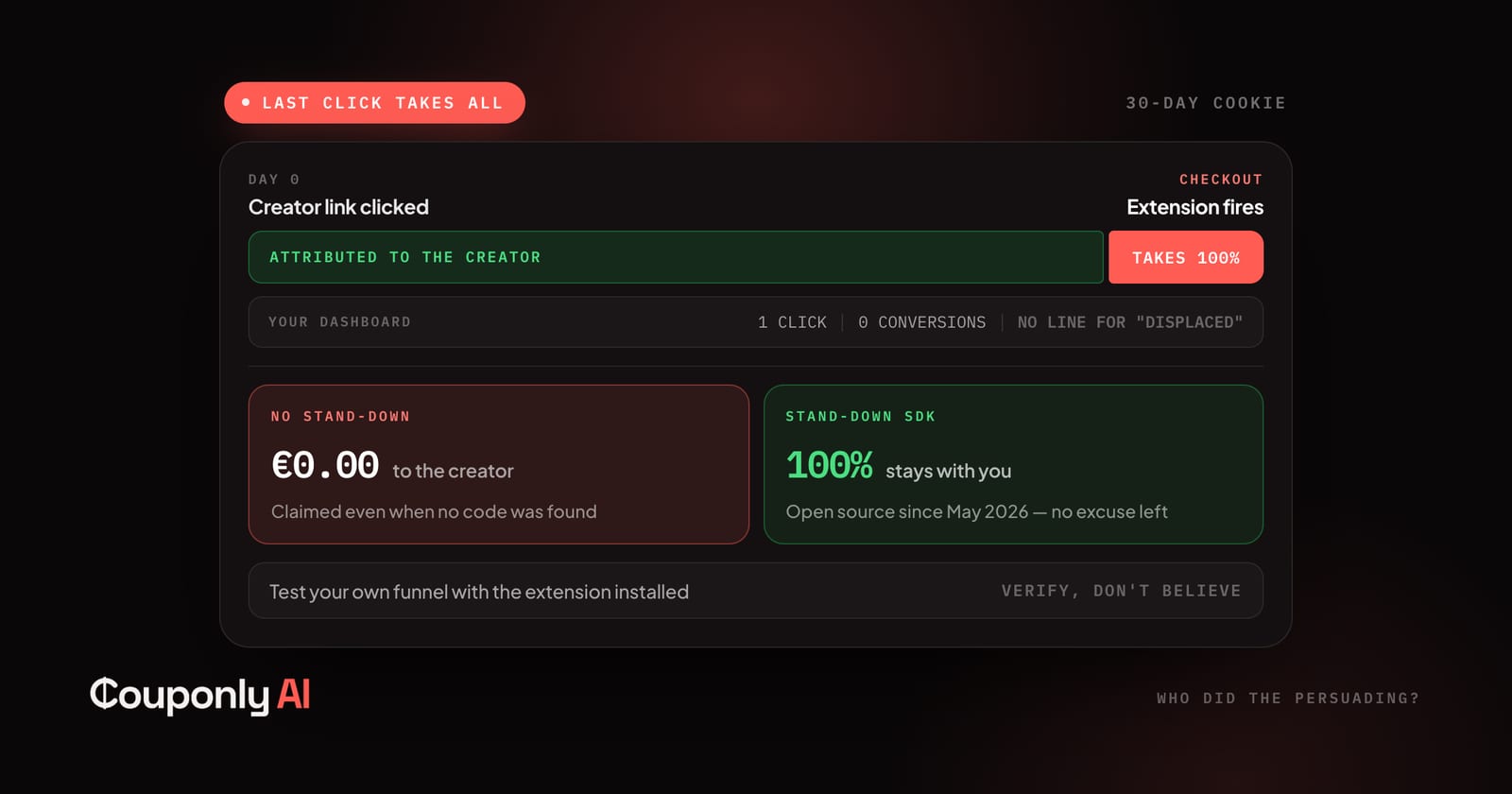
What Creators Should Know About Attribution
You sent the customer. Someone else got paid. Here's the mechanism, what the 2026 enforcement changed, and what to check on your own links.
Couponly Editorial
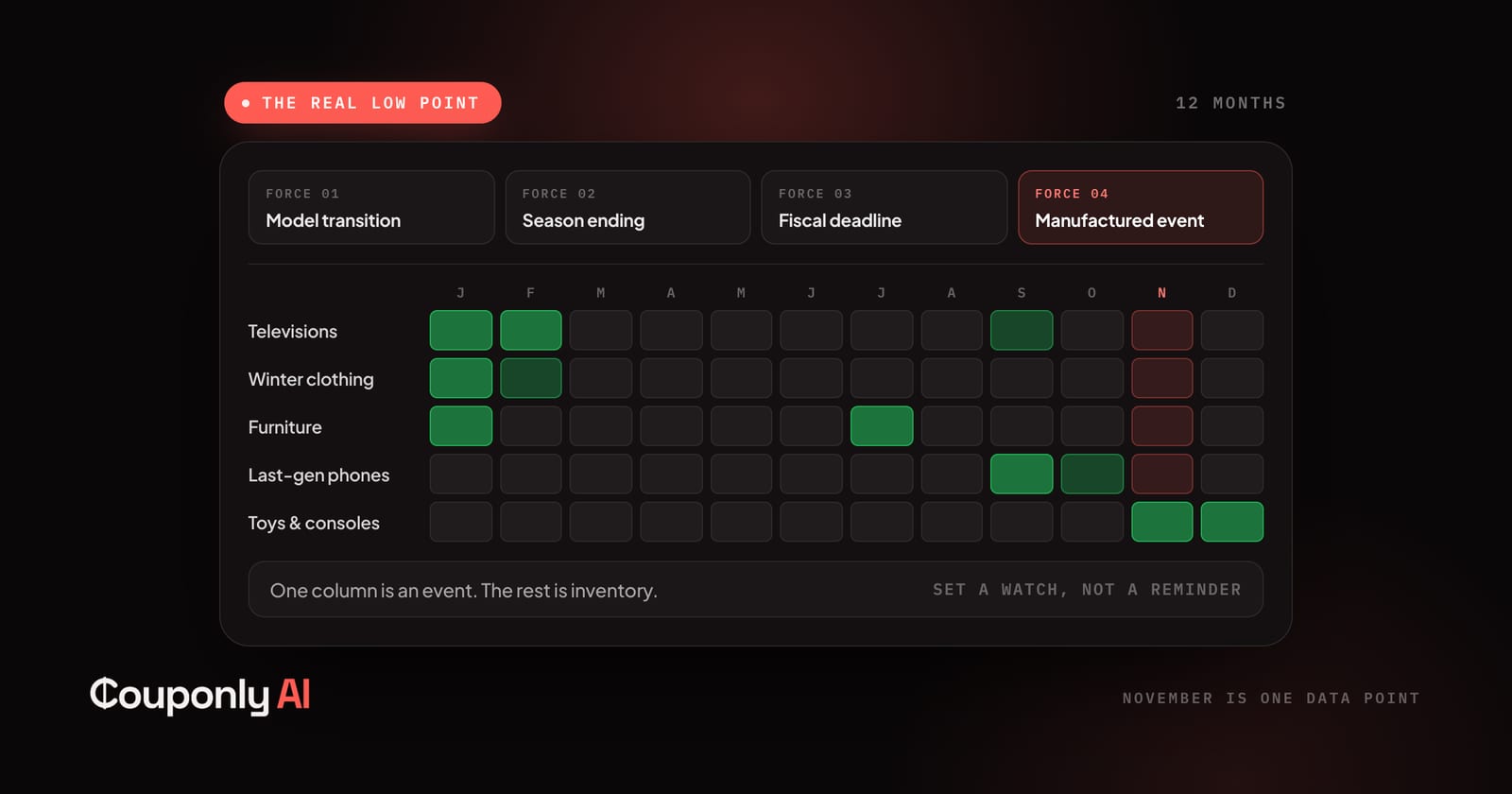
The Discount Calendar: When Things Go on Sale
Sale events are marketing. Product cycles and season endings are structural — and they're what actually move prices. Here's the calendar month by month.
Couponly Editorial