How Do Coupon Extensions Make Money?
They're free because merchants pay them a commission — not because they're charities. Here's how that money moves, why last-click attribution turned it into a scandal, and what it means for what you actually pay.

A coupon extension that costs nothing still has to pay for servers, engineers, and a team that keeps tens of thousands of stores updated. So where does the money come from — and does any of it come out of your pocket?
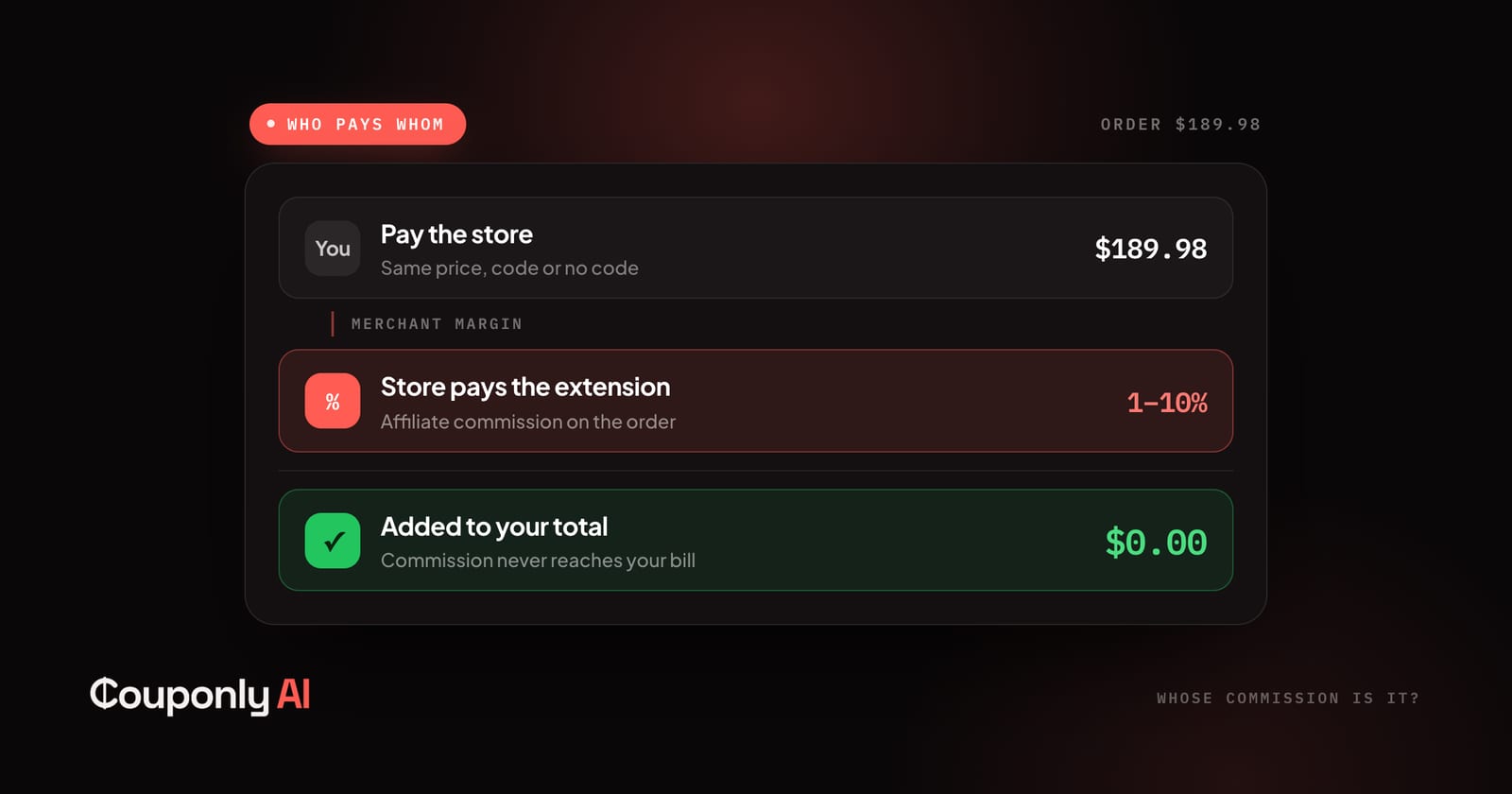
Short answer: coupon extensions earn affiliate commission paid by the merchant, not by you. When you buy something after the extension has been involved in your visit, the store pays it a percentage of the order — typically 1–10%. Your price is unchanged. The controversy in this industry has never been about that commission existing. It's about whose commission it is.
That distinction is what got the biggest extension in the category thrown off three affiliate networks in January 2026. It's worth understanding properly, because it's the single best way to tell a trustworthy shopping tool from an extractive one.
Affiliate commission, in one paragraph
Almost every large online store runs an affiliate programme. The store agrees to pay a commission to partners who send it customers — bloggers, YouTubers, price-comparison sites, cashback apps, loyalty programmes, and browser extensions. The partner gets a tracking link. When a shopper follows that link and buys, the store's system credits the partner and pays out a percentage of the order value.
The shopper pays exactly the same either way. Commission comes out of the merchant's marketing budget, which is already allocated whether an affiliate is involved or not. This is why virtually every free coupon site and extension exists, and there's nothing wrong with the model in itself. We say the same thing plainly in how we make money in our own Terms.
The hard part is the next question: when five different partners touch a single purchase, who gets paid?
Last-click attribution: the rule that causes all the trouble
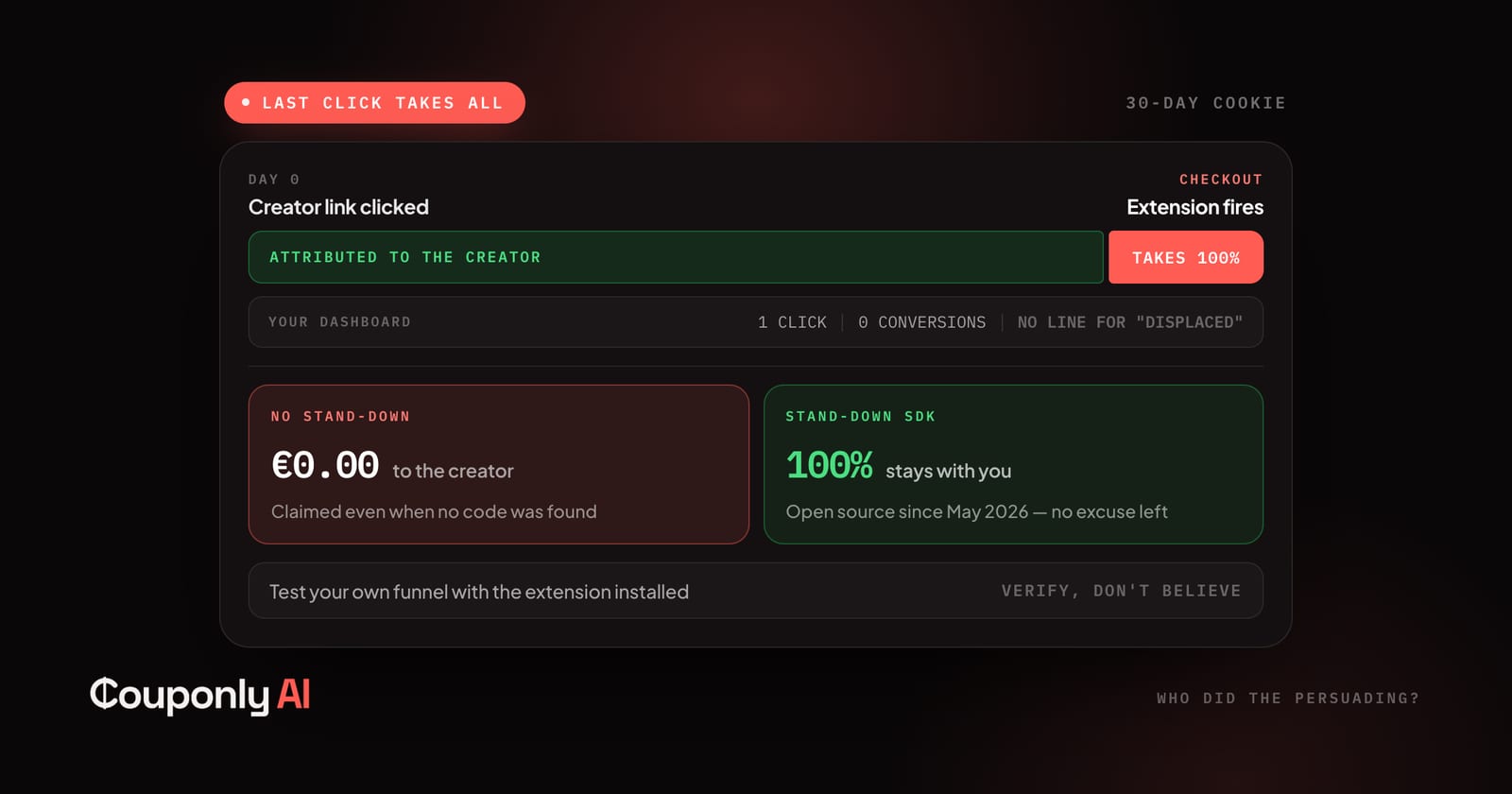
The overwhelming majority of affiliate programmes settle that question with last-click attribution. Whoever's tracking link was clicked most recently before the purchase takes the entire commission. Not a split. Not a share. All of it.
Picture a real shopping journey:
You watch a review video. The creator has a link in the description. You click it. Creator's cookie is set.
You browse the store for ten minutes, adding things to your cart.
At checkout, a coupon extension pops up and offers to find you a code.
You click it.
You buy.
Under last-click, step 4 can overwrite step 1. The creator who actually persuaded you to buy earns nothing. The extension that appeared at the final second earns the full commission — even in the cases where it found no working code at all and saved you nothing.
That is the whole controversy in five steps. The money isn't taken from you. It's taken from whoever sent you there.
The industry's own answer: the stand-down rule
Affiliate networks are aware of this, and the accepted fix has a name: a stand-down rule (sometimes "soft click" or a non-intrusive attribution policy). A well-behaved extension is supposed to detect that an affiliate attribution is already attached to your visit and not overwrite it. It only claims commission when it genuinely brought something to the transaction — an actual working discount, on a visit nobody else had already earned.
A tool that follows the stand-down rule earns less. That's the point. It's a deliberate decision to take money only when the tool has done something worth paying for.
Couponly follows it. If you arrived at a store through a creator's link, we leave that attribution alone — the extension being installed doesn't change who gets credited. It's stated on our trust page and written into our Terms, and it isn't an abstract commitment: it's the difference between a tool that helps you and a tool that quietly bills a third party for your decision.
What actually happened, 2024–2026
This stopped being a theoretical concern in late 2024. The sequence is a matter of public record:
December 2024 — An investigation by tech journalist MegaLag documents Honey allegedly diverting affiliate commissions from content creators.
December 2024 — Creators file a class action against PayPal in the Northern District of California.
November 2025 — The court denies PayPal's motion to compel arbitration, letting the case proceed.
December 2025 — A security researcher publishes findings on code allegedly designed to conceal the behaviour from network compliance testers.
12 January 2026 — Rakuten Advertising terminates Honey, cutting access to roughly 2,000 retail programmes.
17 January 2026 — impact.com suspends Honey following a compliance investigation.
21 January 2026 — Awin confirms policy violations and suspends payments.
6 May 2026 — Rakuten Rewards publishes an open-source stand-down SDK on GitHub. Honey implements it and is reinstated on the network.
22 June 2026 — the court denies PayPal's motion to dismiss; the creators' claims proceed.
10 July 2026 — Bloomberg reports allegations against a different shopping extension, Phia.
Three of the largest affiliate networks in the world took enforcement action against the same extension within ten days. The merchants affected by the Rakuten termination alone included names most shoppers use — the kind of stores you'll find across our store directory, from Walmart to Sephora.
The lesson isn't "coupon extensions are bad." It's that the affiliate industry has begun enforcing a standard that was previously honour-system, and that the standard exists for a reason. PayPal has disputed the characterisation of Honey's practices; the litigation is ongoing. But the network decisions were made independently, by companies with no incentive to lose a large publisher.
Does any of this cost you money?
No — and it's worth being precise about why, because this is where a lot of online explanation goes wrong.
Your price is never higher because a commission was earned. Merchant commission is paid out of the merchant's margin. There is no surcharge mechanism to pass it to you.
A commission can't make a code stop working. Codes are validated by the store's own checkout system, not by the extension.
What you can lose is a better deal, if an extension ranks offers by who pays it most rather than by what actually saves you the most. That's the real consumer cost, and it's invisible unless the tool tells you how it ranks.
So the question to ask an extension isn't "do you make money?" — they all do. It's "what decides the order of what you show me?"
Ours is answered publicly: freshness, measured success rate, and price. Merchants cannot pay for placement, and we don't accept payment to mark a code as working.
How to vet any shopping extension in five minutes
Use this on us as readily as on anyone else.
1. Find the money page. A tool that's comfortable with its business model has a page explaining it in plain language, not one clause buried on page four of the Terms. If you can't find it in thirty seconds, that's an answer.
2. Look for a stated stand-down policy. Does it say what happens when you arrived via someone else's affiliate link? Silence here is the single strongest warning sign, because it's the exact thing the 2026 enforcement actions were about.
3. Check what ranking is based on. "Best offers" means nothing. Look for named criteria. If paid placement is possible, it has to be disclosed somewhere — find that disclosure and read it.
4. Read the permissions before you install. An extension that applies codes at checkout needs to read store pages. It does not need your payment details, your keystrokes, your form contents, or your browsing history. Ours reads catalogue facts from product pages and discards the rest, sends data to one server, and gives you real off switches — the specifics are in our Privacy Policy and summarised on the extension page.
5. Find out who operates it. A registered company, a named jurisdiction, a working email address. Couponly is run by a private limited company registered in Estonia, and the registry details are in our Terms. If a tool won't tell you who it is, don't let it watch you check out.
Where Couponly stands
We built Couponly after this model had already been broken publicly, which is a strange advantage: we got to design around the failure instead of apologising for it later.
Concretely, that means codes are AI-tested against real checkouts rather than pulled from a stale user-submitted list; ranking is driven by freshness, success rate, and price with no paid placement; existing affiliate attribution is left intact; and the extension never touches payment details or browsing history. When we say a code is verified, it means our systems recently observed it working — a freshness signal, not a promise, since only the merchant controls eligibility. We'd rather state that limit than imply a guarantee we can't keep.
The full version of all of it, including the parts that constrain us, is on why you can trust Couponly. If you'd rather just start saving, browse by category or look at today's deals.
Where that leaves the alternatives, and how to judge any of them, is in Honey alternatives in 2026.
Frequently asked questions
Do coupon extensions cost money to use?
The major ones, including Couponly, are free. They're funded by affiliate commission paid by merchants, so there's no subscription and no fee at checkout.
Do I pay more when a coupon extension earns a commission?
No. Commission is paid from the merchant's marketing budget and doesn't change your total. If a code or link changes your price at all, it lowers it.
What is last-click attribution?
It's the rule most affiliate programmes use to decide who gets paid: the partner whose tracking link was clicked most recently before the purchase receives the full commission. It's why an extension appearing at checkout can displace the creator who actually sent you.
Do coupon extensions steal from content creators?
Some have been credibly accused of it. In January 2026, Rakuten Advertising, impact.com, and Awin each took action against PayPal's Honey over attribution practices, following a class action filed by creators in late 2024. Not all extensions behave this way — the ones that don't apply a stand-down rule and leave existing attribution alone.
How can I tell if a coupon extension is trustworthy?
Check five things: it explains how it makes money in plain language, it states a stand-down policy on existing affiliate links, it names its ranking criteria, it requests no more browser permissions than the job needs, and it identifies the company operating it.
Does Couponly overwrite affiliate links?
No. If an affiliate attribution is already attached to your visit — a creator's link you followed to the store — we don't overwrite it just because Couponly is installed.
Keep reading
The Discounts That Never Get Listed
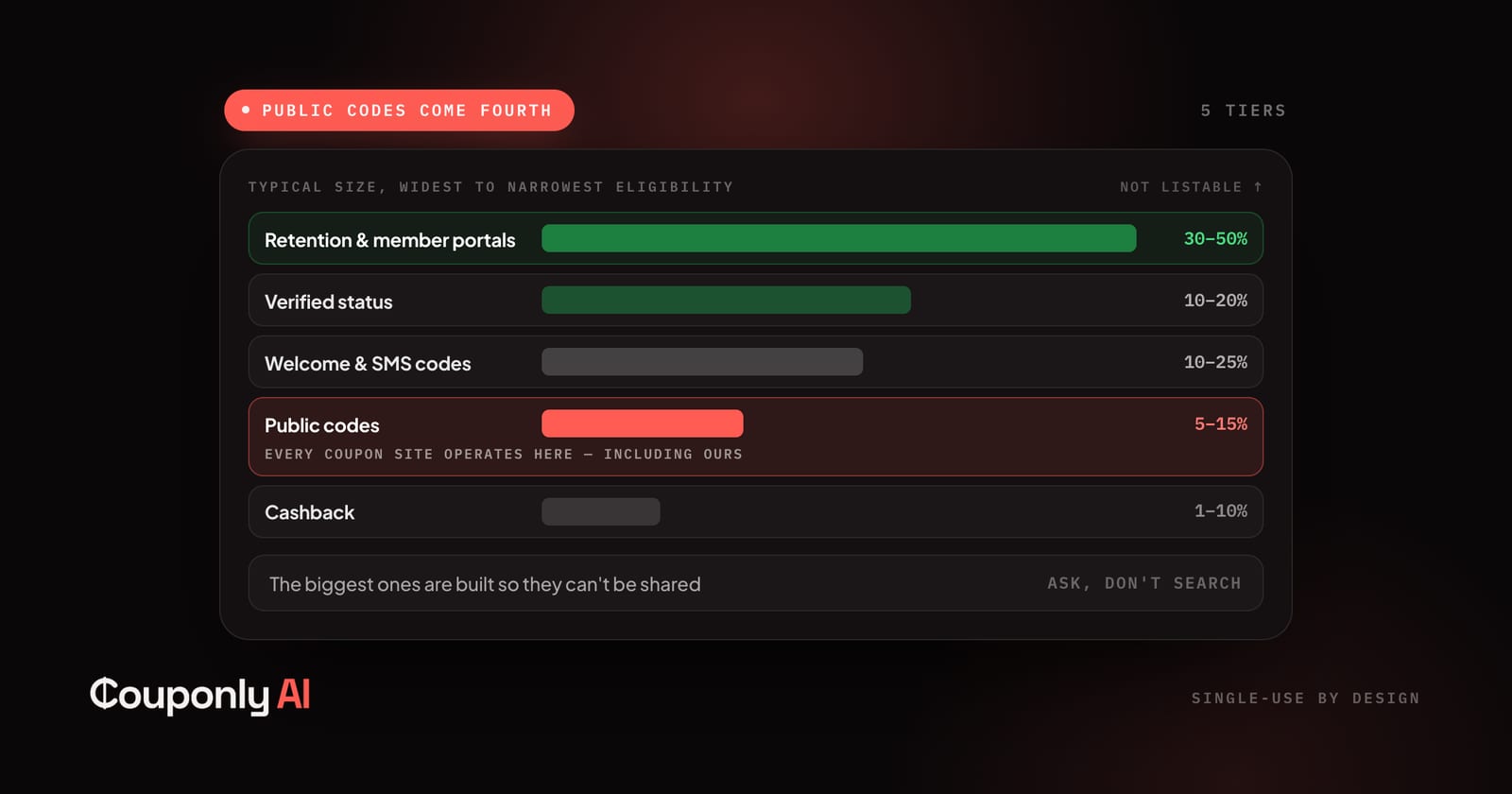
The largest discounts merchants issue never reach a coupon site, because they're built so they can't be shared. Here are nine, and how to get each.
Couponly Editorial
What Creators Should Know About Attribution
You sent the customer. Someone else got paid. Here's the mechanism, what the 2026 enforcement changed, and what to check on your own links.
Couponly Editorial
The Discount Calendar: When Things Go on Sale
Sale events are marketing. Product cycles and season endings are structural — and they're what actually move prices. Here's the calendar month by month.
Couponly Editorial