
Honey Alternatives in 2026: What Changed
The story didn't end where most articles leave it. Here's where things actually stand, the four kinds of alternative, and how to judge any of them.

Most articles with this title were written in January and never updated. They tell you Honey was thrown off three affiliate networks and leave it there — which was true then and is incomplete now.
Short answer: the situation moved. Honey was terminated by Rakuten Advertising in January 2026, suspended by impact.com and Awin in the same month, and returned to Rakuten in May after implementing an industry stand-down SDK. PayPal says the disputed code was deactivated. Meanwhile the class action survived a motion to dismiss in June. So "Honey is finished" is not accurate, and neither is "nothing happened."
What you actually want isn't a list of replacements. It's a way to judge any of them — because the thing that went wrong was structural, and a different logo doesn't fix structure.
Where things stand, briefly
The sequence matters more than any single event:
December 2024 — investigations by MegaLag and economist Ben Edelman document alleged commission diversion.
January 2026 — Rakuten Advertising terminates Honey; impact.com suspends it; Awin confirms policy breaches and suspends payments. PayPal deactivates the disputed code and says it affected under 0.1% of Honey's traffic.
May 2026 — Rakuten Rewards publishes an open-source stand-down SDK on GitHub. Honey implements it and is reinstated on the network.
June 2026 — the court denies PayPal's motion to dismiss; the creators' claims proceed.
July 2026 — Bloomberg reports allegations against a different shopping extension, Phia.
Two things follow from that. First, the industry now has a technical standard for the behaviour that was in dispute, alongside a draft code of conduct for affiliate browser extensions. Second, the last item on that list is the important one: this was never a story about one company. The incentive that produced it applies to every extension in the category. If you want the mechanics, we covered them in how coupon extensions make money.
The four kinds of alternative
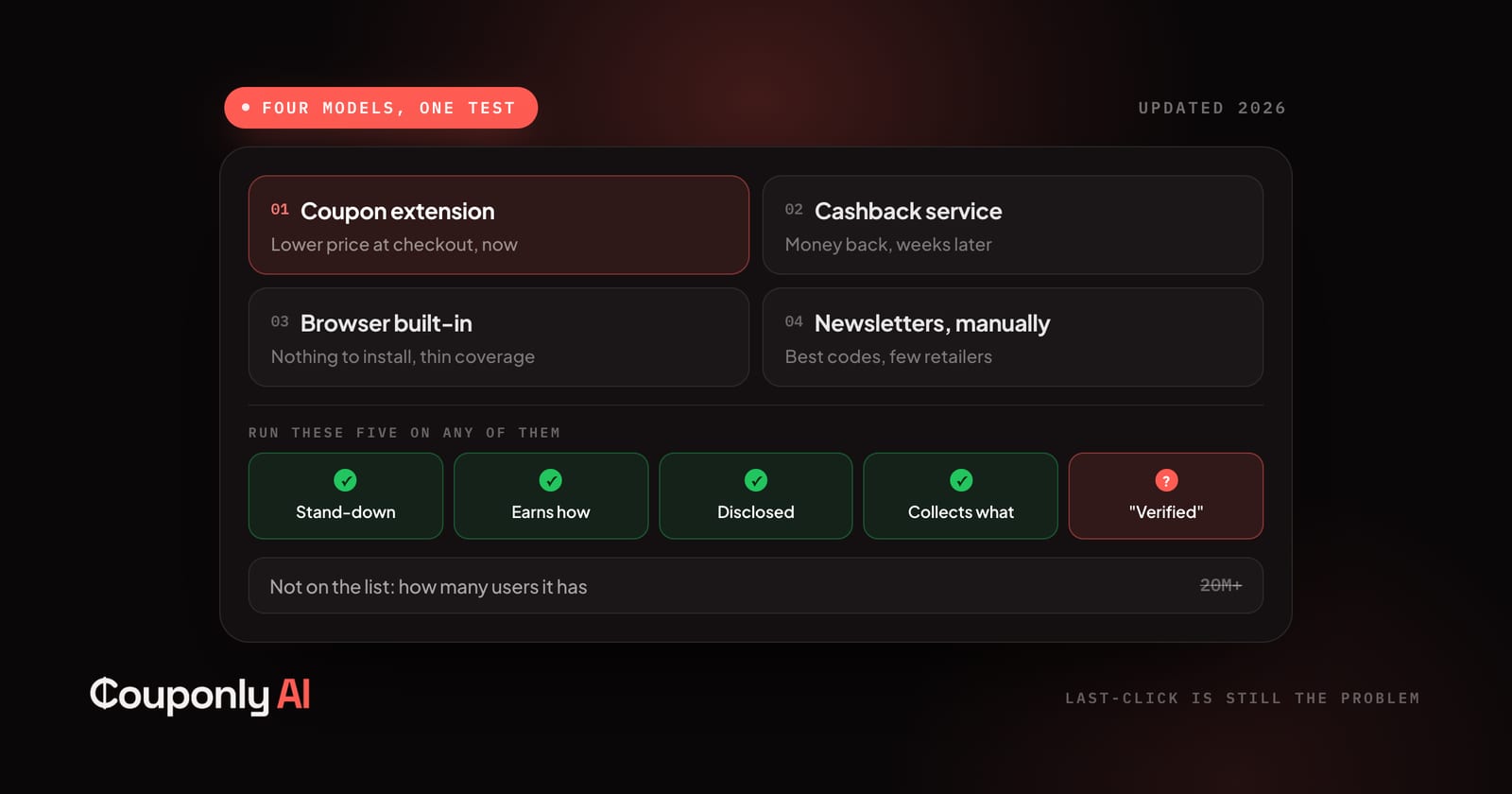
"Alternative to Honey" isn't one thing. There are four models, and they suit different people.
1. Another coupon extension
The direct swap: something that finds and applies codes at checkout. Coupert, Capital One Shopping, and Couponly are in this category, along with a long tail of smaller tools.
Good if you shop across many different retailers and don't want to think about codes.
Watch for exactly what went wrong before — whether the tool overwrites existing affiliate attribution, and whether it discloses how it earns. Both are checkable from outside.
2. A cashback service
Rakuten, TopCashback, and similar services pay you a share of the commission instead of keeping it. Some run browser extensions, some work through links on their site.
Good if you're willing to activate an offer before shopping, and you'd rather have money back than a discount at checkout.
Watch for the payout threshold and schedule — cashback often takes weeks or months to confirm, and small balances can sit unpaid for a long time. Also note that cashback and coupon extensions can conflict: whichever touches your visit last usually takes the commission, which is the same attribution problem viewed from the other side.
3. Your browser's built-in shopping features
Chrome and Edge both have native price tracking and, in some regions, coupon suggestions. No installation, no third party.
Good if your main concern is not installing anything at all.
Watch for coverage. Native features tend to work on large retailers and not much else, and availability varies by country.
4. Doing it manually
Coupon sites, retailer newsletters, and the store's own promotions page.
Good if you shop at a small number of retailers regularly. A store's own newsletter frequently beats every extension on the market, because first-order and subscriber codes are often the largest discounts a merchant issues and they're rarely public.
Watch for stale listings. Most coupon sites don't remove expired codes, which is why so many of them fail.
How to judge any of them
Five checks. They work on Honey, on us, and on anything else.
1. Does it state a stand-down policy? This is the specific behaviour the 2026 enforcement actions were about: whether the tool overwrites an affiliate attribution that's already attached to your visit — a creator's link you followed to the store. Since May there's an open-source SDK for detecting exactly this, so "it's technically difficult" is no longer an answer.
2. Does it explain how it makes money? In plain language, on a findable page, not buried in the Terms. Every one of these tools earns from merchant commission. The ones that won't say so are telling you something.
3. Is its affiliate programme disclosed in the store listing? The Chrome Web Store has required this since June 2025 — listing, interface, and before installation. An extension that skips it is out of compliance with a rule you can look up.
4. What does it collect? Check the Privacy practices tab on the store listing against what the tool plausibly needs. We went through this in detail in are coupon extensions safe.
5. What does "verified" mean when it says it? Usually nothing. Reload the page and see whether the timestamp is a real test or a computed date — the full test is here.
Note that none of these five is "how many users does it have." Honey had over twenty million and it didn't help.
Where Couponly fits — including where it doesn't
We're in category one, so treat this as an interested party describing itself.
What we do differently: codes are tested against real checkouts rather than collected from user submissions; ranking is freshness, measured success rate, and price, with no paid placement; and existing affiliate attribution is left intact. The extension reads catalogue facts from store pages and never payment details, keystrokes, form contents, or browsing history. The full version, constraints included, is on why you can trust Couponly.
Where something else is a better fit:
You want money back rather than a lower price at checkout — use a cashback service. We don't pay cashback and don't pretend to.
You shop almost entirely at one or two retailers — subscribe to their newsletters. You'll get better codes than any extension can find, because the best ones aren't public.
You won't install anything — that's a reasonable position. Use your browser's native features and the retailer's own promotions page.
You need broad coverage of very small or regional merchants — our testing is strongest where checkouts are automatable, and it isn't uniform. Where we can't test properly, that's a gap.
We'd rather say that than claim to be the answer to every version of the question.
To see what's currently live for a specific retailer, start from the store directory or browse by category.
The part worth remembering
The reason this story mattered was never that one extension behaved badly. It's that the whole category runs on last-click attribution, which quietly rewards whoever appears last regardless of whether they helped. That incentive is still there. The SDK and the draft code of conduct are the industry trying to constrain it, and they're a real improvement — but they're constraints on a structure, not a replacement for it.
So the question to carry into any of these tools is the same one: when this thing earns money, what did it do to deserve it? If the answer is "found you a discount," fine. If the answer is "was present at checkout," you know what you're looking at.
Frequently asked questions
Is Honey still working in 2026?
Yes. Honey was terminated by Rakuten Advertising in January 2026 and suspended by impact.com and Awin the same month, but returned to Rakuten in May 2026 after implementing an open-source stand-down SDK. PayPal states the disputed code has been deactivated. The class action brought by content creators is still proceeding after the court denied PayPal's motion to dismiss in June 2026.
What is the best Honey alternative?
It depends what you want. For finding codes at checkout, another coupon extension is the direct swap. If you'd rather receive money back than a discount, a cashback service like Rakuten or TopCashback is a different model entirely. If you shop at only a few retailers, their own newsletters usually offer better codes than any extension can find.
Is Honey safe to use now?
The specific code at issue has been deactivated according to PayPal, and Honey has implemented the industry stand-down SDK required to return to Rakuten's network. Whether that satisfies you is a judgement call. The same five checks apply to Honey as to any other extension: stated stand-down policy, disclosed business model, affiliate disclosure in the store listing, declared data collection, and what it means by "verified."
Do coupon extensions still take commission from creators?
The practice is now constrained rather than eliminated. Since May 2026 there's an open-source SDK for detecting when an affiliate attribution is already attached to a visit, and a draft code of conduct for affiliate browser extensions is in public comment. Extensions that implement stand-down leave existing attribution alone; those that don't, still don't.
Is cashback better than a coupon extension?
They're different, not ranked. Cashback pays you a share of the commission weeks or months after purchase; a coupon extension lowers your price at checkout immediately. Cashback usually requires activating an offer first, and the two can conflict, because whichever touches your visit last generally takes the commission.
Are there free Honey alternatives?
Effectively all of them are free, including Honey itself. Coupon extensions and cashback services are funded by merchant commission rather than by users, so the meaningful question isn't price — it's what a given tool does to earn that commission.
Keep reading
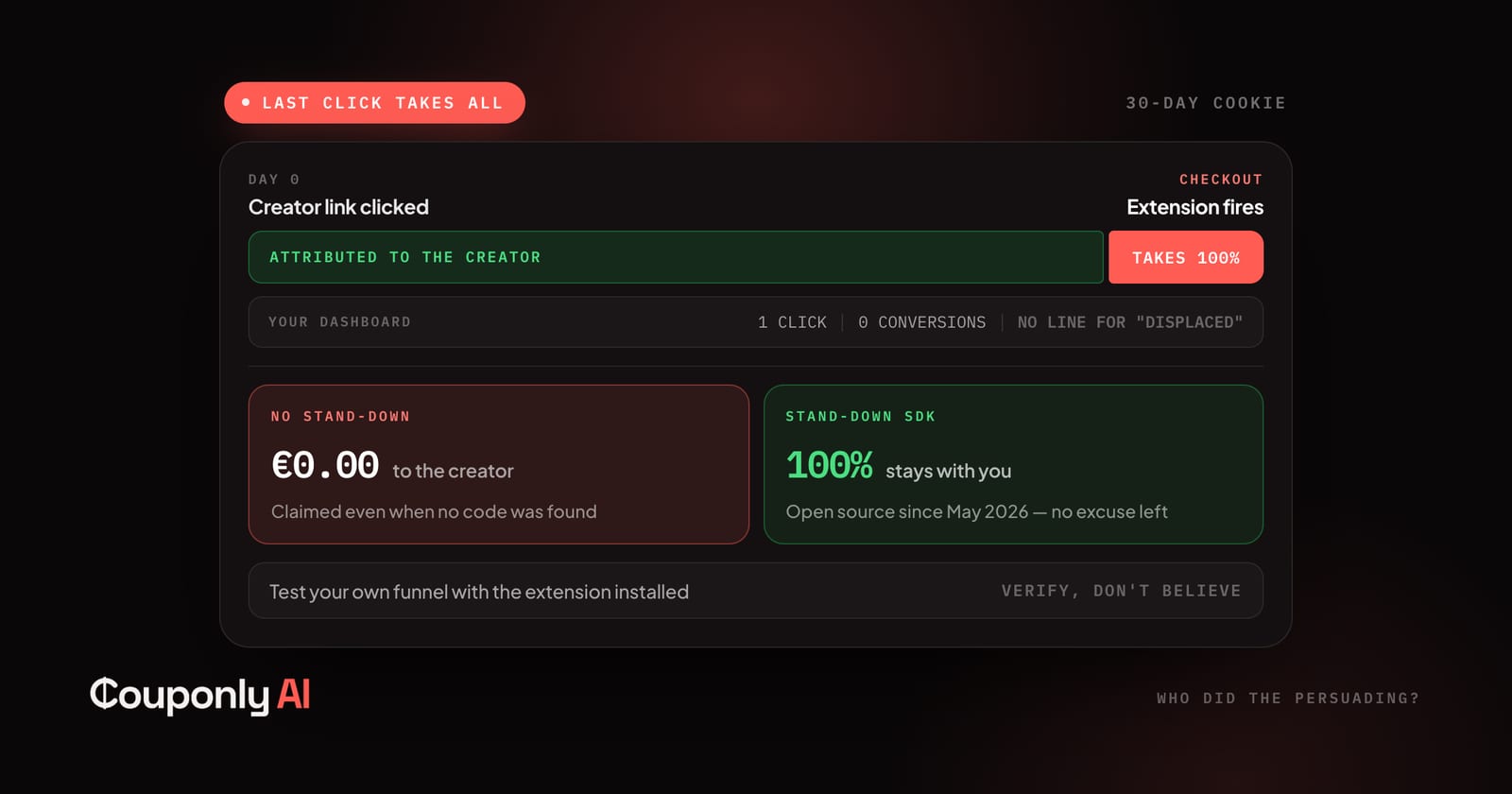
What Creators Should Know About Attribution
You sent the customer. Someone else got paid. Here's the mechanism, what the 2026 enforcement changed, and what to check on your own links.
Couponly Editorial
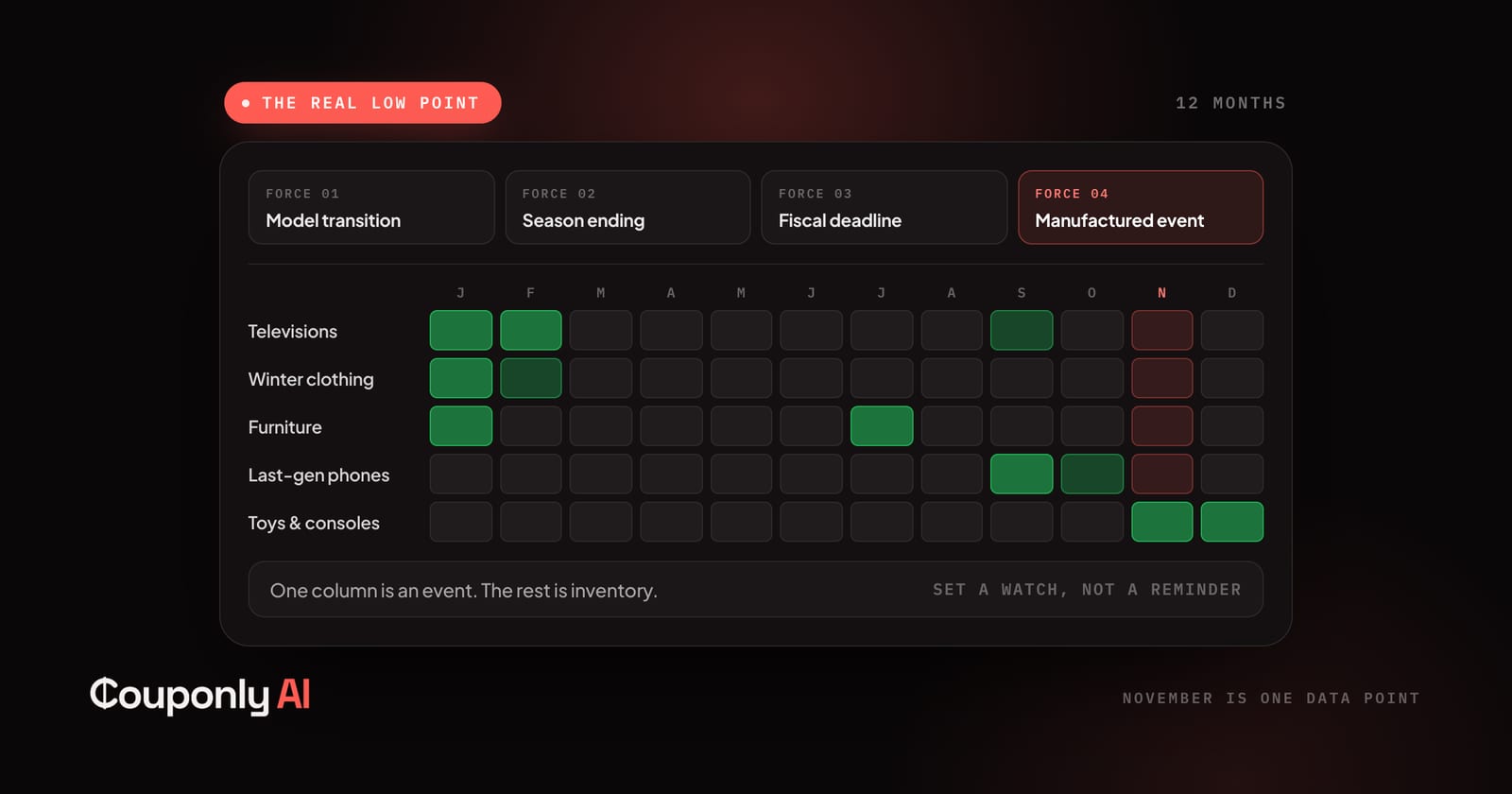
The Discount Calendar: When Things Go on Sale
Sale events are marketing. Product cycles and season endings are structural — and they're what actually move prices. Here's the calendar month by month.
Couponly Editorial
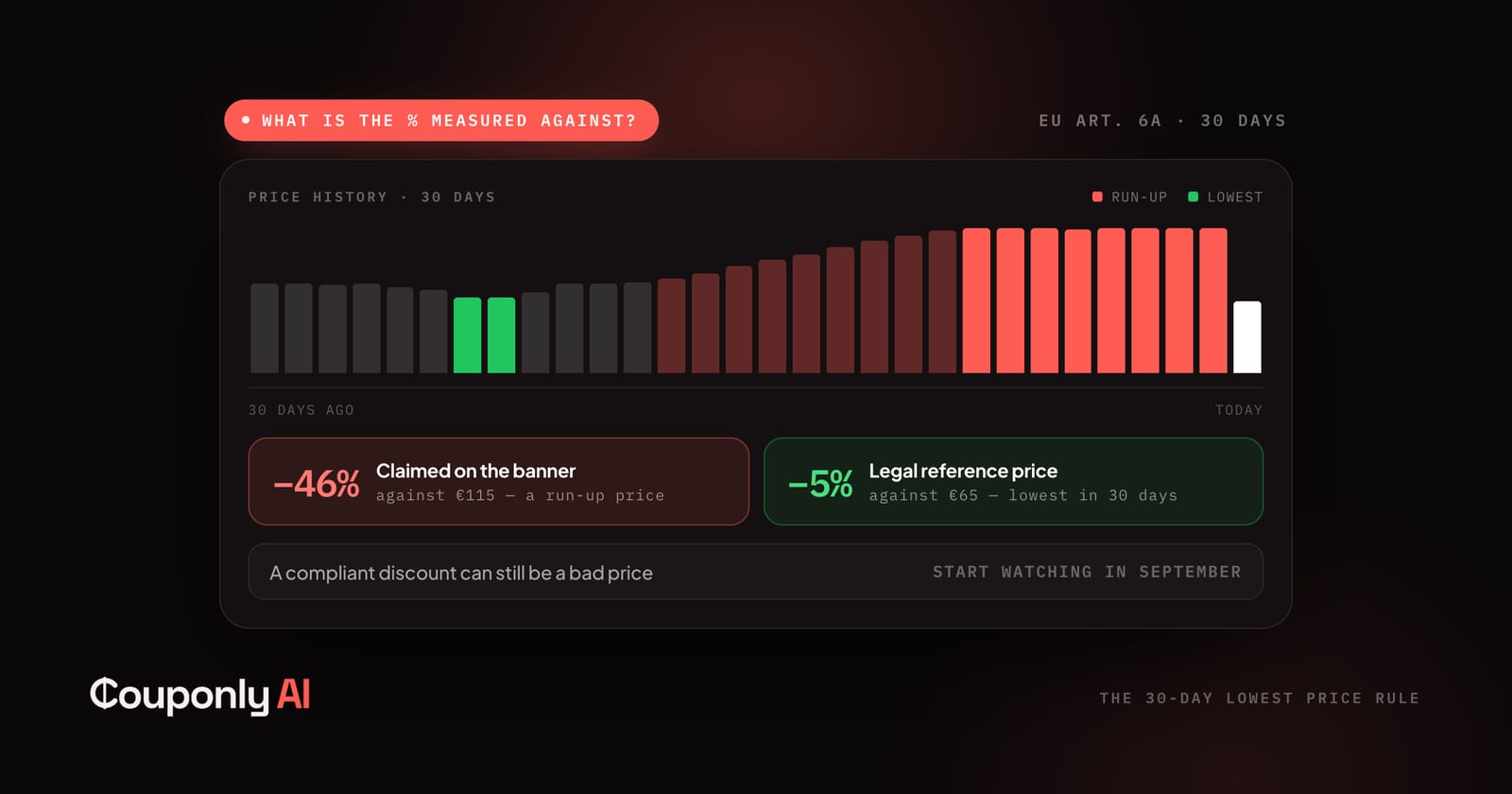
Black Friday: When the Discount Is Real
The oldest trick in retail is inflating a price so the discount looks bigger. EU law now bans it — here's what the rule covers and what it misses.
Couponly Editorial